How high planes fly
Cruising altitude depends mostly on what the airplane is built for. Jets fly high. Small propeller airplanes fly low.
| Aircraft | Typical cruise altitude | Highest certified or operating altitude |
|---|---|---|
| Narrowbody airliner (Boeing 737 MAX 8) | 31,000 to 38,000 feet | 41,000 feet |
| Widebody airliner (Airbus A350-900) | 31,000 to 38,000 feet | 43,100 feet |
| Business jet (Gulfstream G700) | Varies by trip | 51,000 feet |
| Small training airplane (Tecnam P-Mentor) | A few thousand feet | 13,000 feet |
| Concorde, retired 2003 | About 56,000 feet | 60,000 feet |
| NASA ER-2 research jet | 70,000 feet | 70,000 feet |
| Lockheed U-2 spy plane | Above 70,000 feet | 74,600 feet with the later engine |
Pilots usually talk about high altitudes as flight levels. FL350 means 35,000 feet on an altimeter set to the standard pressure of 29.92 inches of mercury. In the US every airplane switches to flight levels above 18,000 feet, so everyone up there is measuring height from the same reference.
Why do planes fly so high
Thinner air. The higher you go, the less dense the air. A jet's most economical speed is higher in thin air, so it covers more ground for the fuel it burns. There is a limit, because engines also lose thrust as the air thins. The best altitude is where those two balance, and it rises during the flight as fuel burns off and the airplane gets lighter.
Weather. Cruising high keeps an airliner above much of the weather, but not all of it. Mature thunderstorms often reach 40,000 to 60,000 feet, so airliners fly around them, not over.
Wind. The jet stream sits around 30,000 feet and can blow at more than 275 mph. It blows west to east, which is why eastbound flights are generally faster than westbound flights on the same route.
Traffic. Altitude is how air traffic is kept apart. Above 18,000 feet, air traffic control assigns every flight its altitude. Below that, pilots flying by sight follow a simple rule set out in 14 CFR 91.159:
| Direction of travel (magnetic course) | VFR cruising altitude, above 3,000 feet over the ground |
|---|---|
| 0 to 179 degrees, roughly east | Odd thousands plus 500 feet: 3,500, 5,500, 7,500 |
| 180 to 359 degrees, roughly west | Even thousands plus 500 feet: 4,500, 6,500, 8,500 |
So two small airplanes following the rule on opposite headings are always at least 1,000 feet apart.
How fast planes fly
| Aircraft | Cruise speed | In miles per hour |
|---|---|---|
| Narrowbody airliner (Airbus A320, Boeing 737NG) | Mach 0.78, about 450 knots | About 520 mph |
| Widebody airliner (Airbus A350, Boeing 787) | Mach 0.85, about 490 knots | About 560 mph |
| Business jet (Gulfstream G700) | Mach 0.85 long range, Mach 0.90 high speed | Maximum Mach 0.935 |
| NASA ER-2 | 410 knots | About 470 mph |
| Small training airplane (Tecnam P-Mentor) | 117 knots maximum cruise | About 135 mph |
| Concorde | Mach 2.02 | About 1,330 mph |
Jets measure cruise speed in Mach, the airplane's speed as a fraction of the speed of sound. The speed of sound is about 760 mph at sea level on an average day and drops as you climb, so Mach 0.85 is fewer miles per hour at 38,000 feet than it would be near the ground.
The fastest airliner flights
The speed on the seatback map is ground speed: airspeed plus or minus the wind. With a strong jet stream behind it, an ordinary airliner can show numbers that look supersonic.
In February 2020, British Airways flight 112, a Boeing 747, flew from New York to London in 4 hours 56 minutes, a record for a subsonic airliner on that route. Its ground speed peaked above 800 mph. Flightradar24 estimated the wind added roughly 150 mph of it.
How fast does a plane take off and land
| Aircraft | Takeoff speed | Landing approach speed |
|---|---|---|
| Boeing 737 | About 150 mph (130 knots) at 100,000 lb | 130 knots (737-700) to 142 knots (737-800), about 150 to 165 mph |
| Airbus A320 | About 170 mph (150 knots) | Not listed in our sources |
| Airbus A350-900 | Not listed in our sources | 145 knots, about 165 mph |
| Boeing 747 | About 180 mph (155 knots) at 800,000 lb | 157 knots (747-400), about 180 mph |
| Concorde | About 250 mph | About 170 mph |
| Cessna 150 | Around 54 knots, about 62 mph | Not listed in our sources |
| Piper PA-28R Arrow | Not listed in our sources | 70 knots, about 80 mph |
As a rule of thumb, a jet airliner leaves the ground at around 160 to 180 mph and touches down a little slower, around 150 to 180 mph. A small training airplane does both at well under 100 mph.
Heavier airplanes need more speed to lift off, which is why a fully loaded 747 is faster down the runway than a 737.
Small training planes: our Tecnam P-Mentor
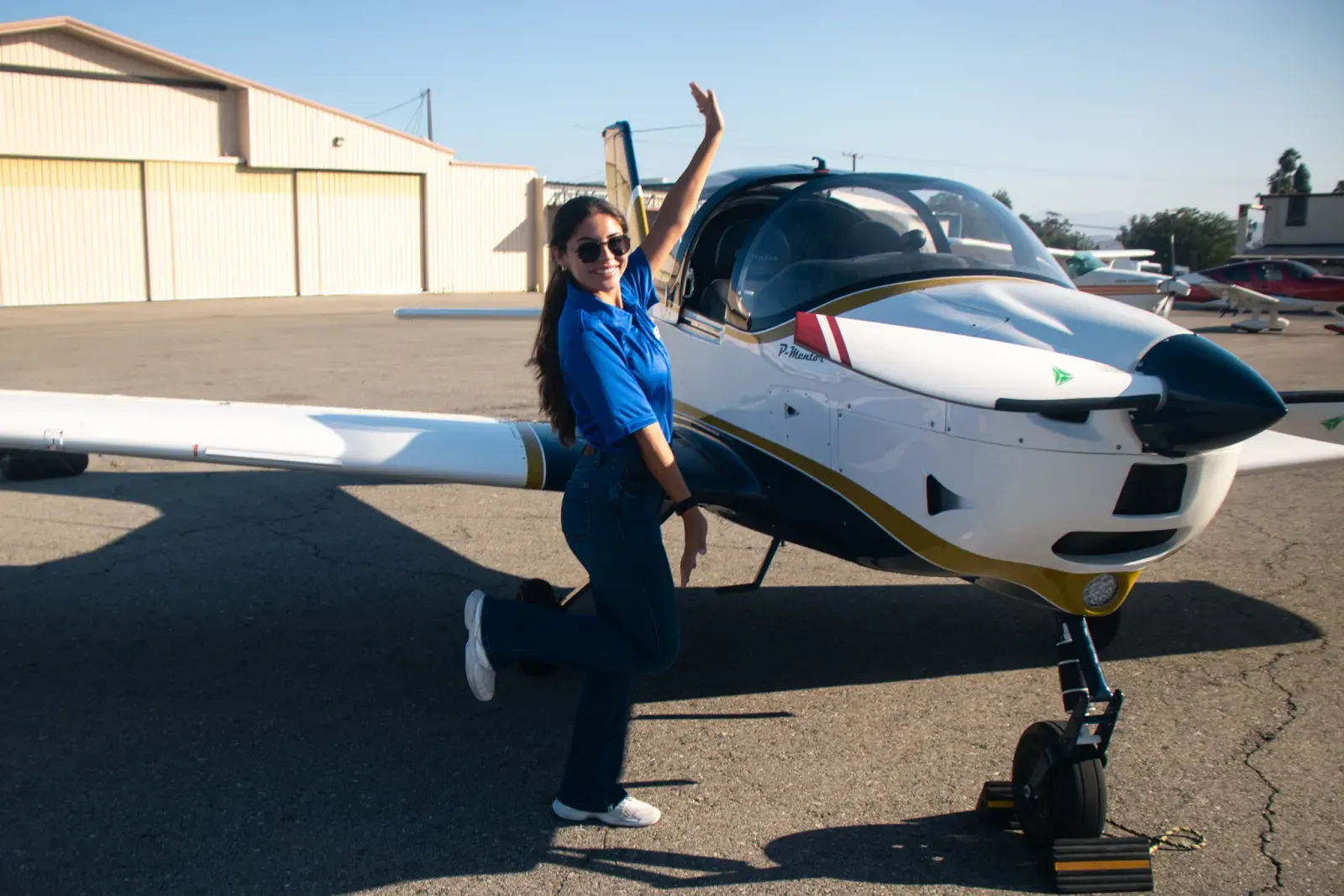
Most people never see the low end of the table from the inside. Every airplane in our fleet at Riverside Municipal Airport (KRAL) is a factory-new 2024 Tecnam P-Mentor, and you can see these numbers for yourself from the cockpit on a discovery flight.
| P-Mentor figure | Value |
|---|---|
| Maximum cruise speed | 117 knots, about 135 mph |
| Maximum operating altitude | 13,000 feet |
| Stall speed, flaps down | 44 knots, about 51 mph |
| Takeoff distance over a 50 foot obstacle | 1,706 feet |
| Range | 950 nautical miles |
A typical training flight stays a few thousand feet up. That is high enough to practice maneuvers safely and to clear the FAA minimums of 1,000 feet over a city and 500 feet over open country (14 CFR 91.119), and low enough to see roads, towns and other airports clearly.
How altitude and speed are measured
| Measure | Unit | What it means |
|---|---|---|
| Altitude | Feet | Height above sea level, read from air pressure |
| Flight level | Hundreds of feet | Altitude on the standard 29.92 setting, used above 18,000 feet in the US |
| Airspeed | Knots | Speed through the air, one nautical mile per hour |
| Mach | Fraction of the speed of sound | Used by jets at high altitude |
| Ground speed | Knots or mph | Speed over the ground, airspeed plus or minus wind |
Pilots use knots because a nautical mile is about one minute of latitude, which makes distances on a chart easy to measure. One knot is about 1.151 mph, or exactly 1.852 km/h. US aviation rules moved to knots in 1969.
Altitude limits and oxygen
Above about 12,500 feet the air is thin enough that the FAA requires oxygen. Airliners solve that with pressurization: by rule the cabin of a transport airplane may not go above an 8,000 foot cabin altitude in normal flight, even when the airplane is at 41,000 feet.
| Rule, 14 CFR 91.211 | Who needs oxygen |
|---|---|
| Cabin altitude above 12,500 up to 14,000 feet | The required crew, for any time over 30 minutes |
| Cabin altitude above 14,000 feet | The required crew, the whole time |
| Cabin altitude above 15,000 feet | Every occupant must be provided with oxygen |
| Pressurized airplane above FL250 | A 10 minute supply for each occupant, for an emergency descent |
| Pressurized airplane above FL350 | One pilot wears a mask, unless two pilots have quick-donning masks and the airplane is at or below FL410 |
The P-Mentor is not pressurized, and its 13,000 foot limit sits just above the 12,500 foot line where the oxygen rule starts.
Numbers vary
Every figure here is a typical or published value, not what a given flight will do.
- Weight. A heavy airplane takes off faster, lands faster and may not be able to climb to its ceiling until it has burned fuel.
- Temperature. Hot air is thinner, so airplanes need longer runways and climb more slowly on hot days.
- Wind. A headwind or tailwind changes ground speed by tens or even hundreds of miles per hour without changing airspeed at all.
- Airline choices. Airlines pick cruise speed and altitude for cost, schedule, weather and traffic, so two flights on the same route can be quite different.
Questions
How high do planes fly?
Airliners typically cruise at about 31,000 to 38,000 feet, and can go to around 41,000 to 43,000 feet. Business jets can reach 51,000 feet, while small propeller trainers usually stay a few thousand feet up.
How fast do planes fly?
A jet airliner cruises at about Mach 0.78 to 0.85, roughly 520 to 560 mph. A small training airplane like the Tecnam P-Mentor cruises at up to 117 knots, about 135 mph.
How fast does a plane take off?
A jet airliner lifts off at about 150 to 180 mph, depending mostly on its weight. A small airplane like a Cessna 150 takes off at around 54 knots, about 62 mph.
How fast does a plane land?
Airliner approach speeds run from about 130 knots for a Boeing 737-700 to 157 knots for a Boeing 747-400, roughly 150 to 180 mph. Small airplanes land well under 100 mph.
Why do planes fly so high?
Thinner air lets a jet fly faster on the same fuel, and high altitudes keep it above most weather and in favorable winds like the jet stream. Altitude also separates traffic, with air traffic control assigning each flight its level above 18,000 feet.
Why do pilots use knots instead of miles per hour?
A knot is one nautical mile per hour, and a nautical mile is about one minute of latitude, which makes navigation on charts simpler. One knot is about 1.151 mph.
Sources
- Wikipedia, cruise (aeronautics): typical cruise altitudes and speeds
- Wikipedia, Boeing 737 MAX specifications
- Wikipedia, Airbus A350 specifications
- Gulfstream, G700 performance
- Tecnam, P-Mentor specifications
- Wikipedia, Concorde
- NASA Airborne Science Program, ER-2
- Wikipedia, Lockheed U-2
- Wikipedia, flight level
- NOAA, the jet stream
- NOAA NESDIS, what is the jet stream
- National Weather Service, thunderstorm life cycle
- NASA Glenn Research Center, Mach number
- Maine Public (NPR), British Airways sets record crossing the Atlantic in under 5 hours, February 2020
- Aerospaceweb, airliner takeoff speeds
- Wikipedia, takeoff
- Wikipedia, aircraft approach category (examples from FAA AC 150/5300-13A)
- Wikipedia, knot (unit)
- 14 CFR 91.159, VFR cruising altitude or flight level
- 14 CFR 91.119, minimum safe altitudes
- 14 CFR 91.211, supplemental oxygen
- 14 CFR 25.841, pressurized cabins
Last reviewed October 2026. Aircraft specifications and speed records change with new models and new flights, so check the source for the latest figure.