

On this page
- What a San Diego Flight Student Is Actually Choosing
- Choose the training arrangement before the airplane
- Compare the complete offer
- San Diego's Aviation Training Market in Context
- A professional training legacy
- Evaluate the airport as part of the school
- The Rating Ladder from PPL to CFII
- Know the purpose of each qualification
- Separate training totals from legal credit
- San Diego School Archetypes Compared
- San Diego Flight School Archetypes Compared
- How I'd evaluate the models
- Where a fixed-price pathway fits
- Airspace, Weather, and the Real Cost of Training in San Diego
- Measure what happens inside the lesson
- Budget for readiness without an appointment
- How to Read Pricing, Financing, and Fine Print
- Turn the quote into an all-in budget
- Finance the realistic amount
- Matching School Types to Common Student Profiles
- If you're starting from zero
- If you already hold a private certificate
- If flexibility or instructing work matters most
- Decision Checklist Before You Sign Anything
- Require evidence, not reassurance
- Write down the trade-off you're accepting
You've probably got several flight-school tabs open, a tuition figure that looks manageable, and a bigger question nobody's answered: can you finish on that budget? Before you put down a deposit, you need to know whether the school can deliver consistent lessons, keep an instructor assigned to you, and get you in front of an examiner when you're ready.
The right way to compare flight schools in San Diego isn't by hourly rental rate alone. Compare what you can accomplish during a lesson, how the school handles interruptions, and who pays when the advertised schedule slips.
What a San Diego Flight Student Is Actually Choosing
Walk into an enrollment meeting with no flight time, and the conversation can move straight to airplanes and financing. Slow it down. Your first decision is whether you're buying an introduction to flying or committing to a professional training pathway.
A private-pilot-first approach lets you test your interest without committing to every subsequent rating. An integrated career track makes more sense when you've already decided to pursue professional flying and can protect your training schedule. Neither approach excuses an unclear contract.
Choose the training arrangement before the airplane
Ask whether your course operates under Part 61 or Part 141, then ask how that changes your actual training plan. Don't accept a regulatory label as evidence that instruction, aircraft availability, or graduation support will be better.
Your location matters just as much. A school across the county might look attractive until its available lesson slots conflict with your commute and work commitments. Choose the airport you can reliably reach, not the airport you enjoyed visiting.
| Decision | Better fit when | Verify before committing |
|---|---|---|
| Private pilot first | You're still testing the career decision | Exit terms and later rating availability |
| Integrated career track | You can commit to concentrated training | Complete scope and interruption policies |
| Local training | You need to keep working nearby | Actual openings around your work schedule |
| Relocation | You can reorganize your life around flying | Housing, transport, and living expenses |
Compare the complete offer
Pay-as-you-go training can limit your initial commitment, but it isn't automatically cheaper overall. A fixed-price pathway can improve budget clarity, but only if the contract explains what happens when you need additional training.
Buying rule: Choose the arrangement you can sustain through interruptions, not merely the one you can afford to start.
Use the same evaluation sheet at every enrollment meeting: published tuition, usable training hours, checkride access, fleet and instructor quality, financing, and exclusions. If an admissions representative can't explain one of those clearly, don't fill in the answer yourself.
San Diego's Aviation Training Market in Context
San Diego's aviation identity predates today's career academies. Glenn Curtiss opened the Curtiss School of Aviation on North Island in 1911, and North Island was commissioned as a Naval Air Station in 1917, according to this history of San Diego's early aviation training.
The region's training history provides useful context for today's career-focused programs.
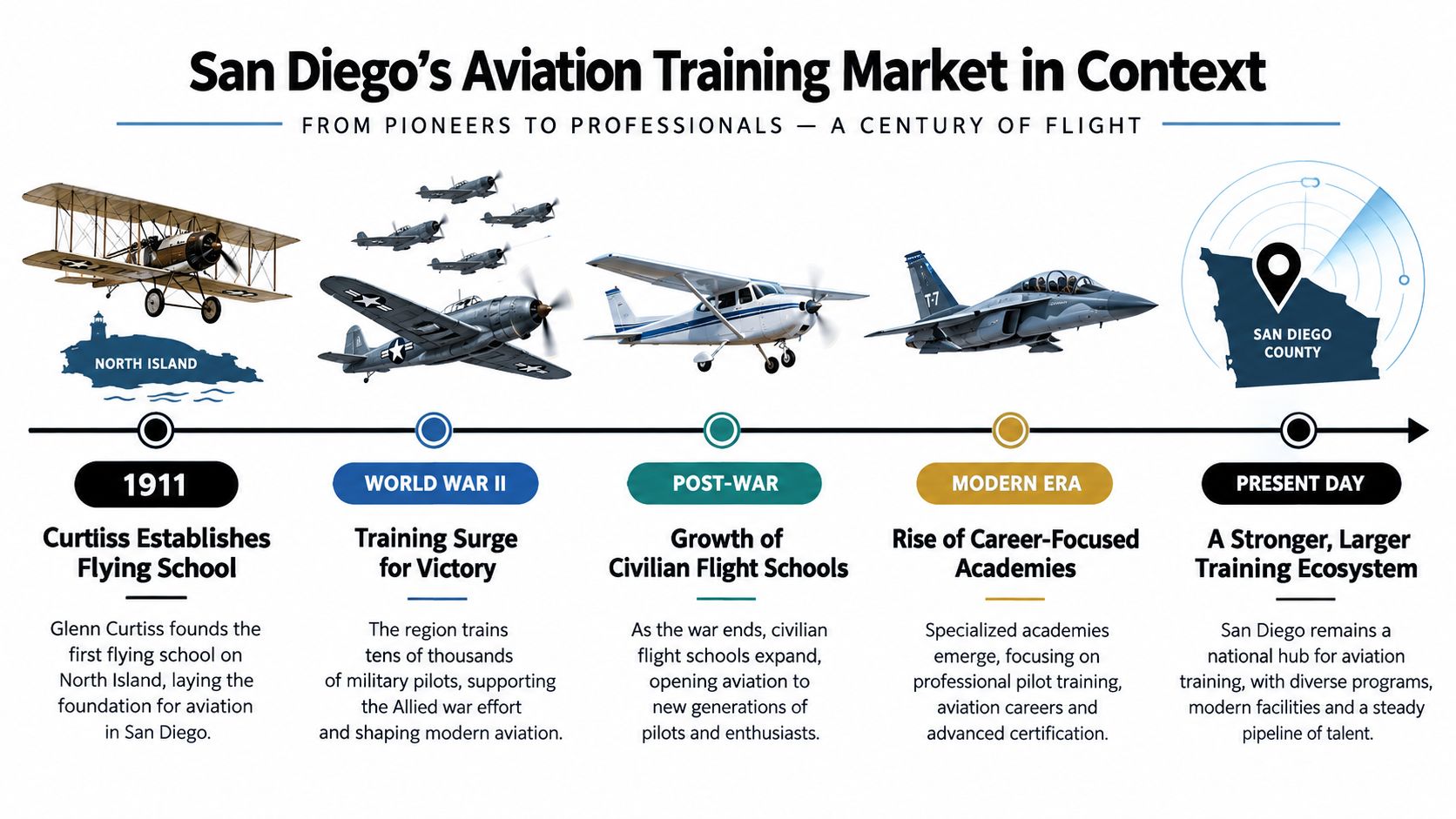
A professional training legacy
During World War II, the Ryan School of Aeronautics expanded its military training work; by the war's end, Ryan had trained approximately 14,000 pilots, while the broader Navy training effort produced approximately 60,000 pilots, as described by the San Diego Air & Space Museum's pilot-training history. Those figures describe different training efforts, not a combined San Diego school enrollment total.
Today's national pipeline is substantial too. The FAA reported 887,519 active pilot certificates and 370,286 active student pilots at the end of 2025, compared with 222,629 student pilots in 2020, in its Civil Airmen Statistics workbook.
That doesn't establish any particular school's enrollment, quality, or completion rate. My recommendation is to treat national demand as context and judge local capacity through booking records and student progress.
Evaluate the airport as part of the school
Montgomery-Gibbs and Brown Field deserve separate operating questions, not a single assumption about “San Diego flying.” Ask how instructors introduce radio work, how they select practice areas, and how they adapt lessons when conditions change.
- Traffic planning: Ask what students practice locally and what requires a departure to another area.
- Weather planning: Request the school's procedure for replacing a canceled flight with productive ground or simulator work.
- Training continuity: Ask who adjusts the syllabus after an interruption.
Use the accompanying video as another prompt for questions about the training environment.
Don't let a historic aviation reputation substitute for evidence about the school you're considering. You're buying its present operating capacity, not the region's past accomplishments.
The Rating Ladder from PPL to CFII
A career program should show you the destination of every training phase. Read the sequence alongside this pilot certification training overview, then require a written breakdown of aircraft time, simulator time, ground instruction, and practical tests.
The progression below helps you match advertised training to the qualifications you're pursuing.
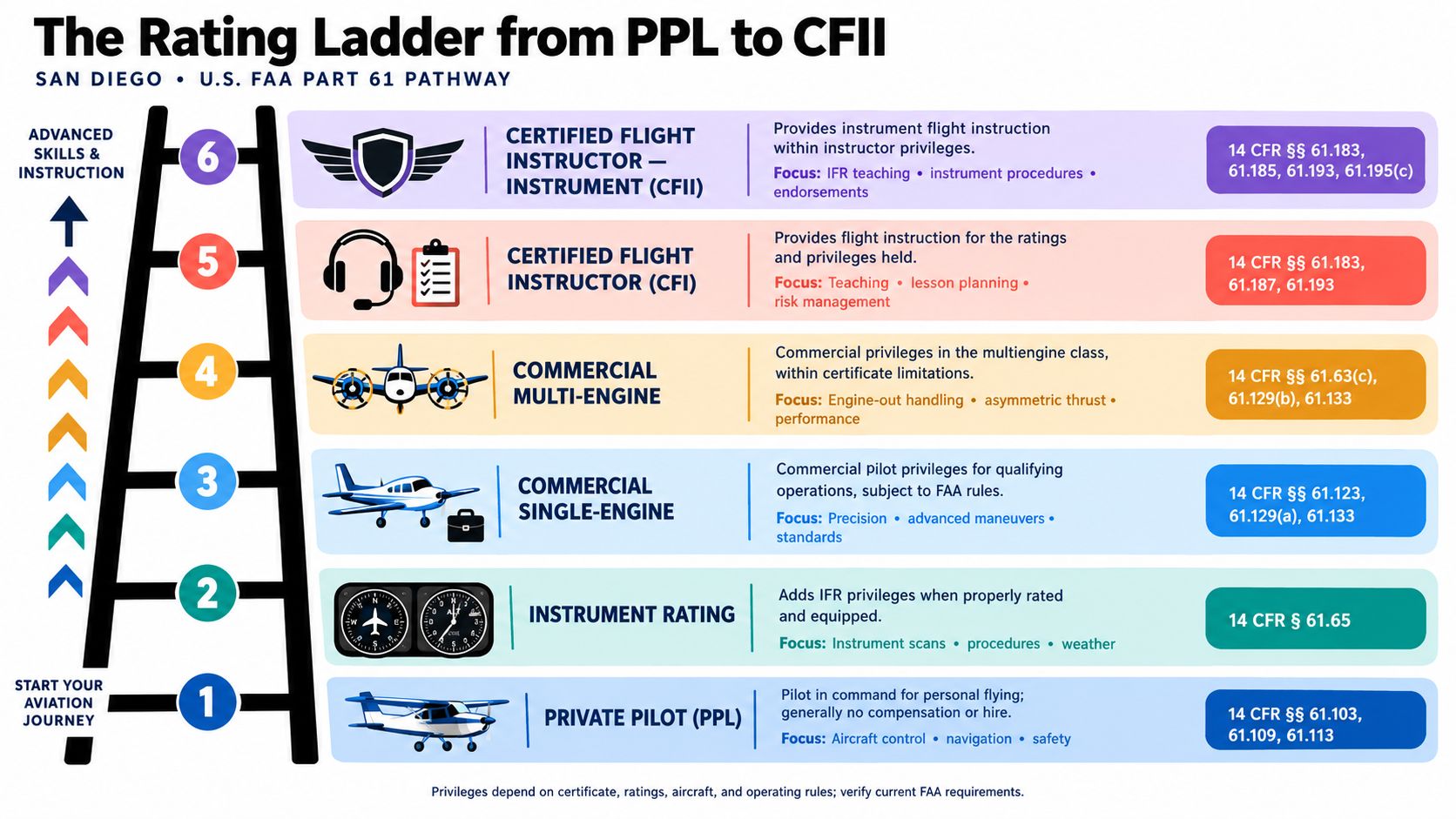
Know the purpose of each qualification
- Private pilot: Build aircraft-control, navigation, planning, and judgment fundamentals. Don't treat this phase as something to rush past.
- Instrument rating: Develop instrument procedures, clearance management, and disciplined cockpit workflows.
- Commercial single-engine: Prepare for commercial certification standards and demonstrate the required aeronautical experience.
- Commercial multi-engine: Develop competence in multi-engine operation and the associated aircraft-management demands.
- Certified flight instructor: Learn to teach, diagnose errors, and evaluate another pilot's performance.
- Instrument instructor: Extend your teaching preparation to instrument flying.
For a commercial airplane single-engine certificate, 14 CFR § 61.129(a) generally requires 250 hours, including specified powered-aircraft, pilot-in-command, cross-country, training, and solo or supervised-PIC experience; the commercial aeronautical-experience regulation gives the controlling detail. A school's advertised total isn't a substitute for that category-by-category audit.
Separate training totals from legal credit
Under the related commercial provisions, qualifying instruction in an appropriate full-flight simulator or flight-training device can receive up to 50 hours of credit toward the total aeronautical-experience requirement, subject to the rule's conditions; approved Part 142 graduates also have a separate 190-hour pathway under specified conditions in 14 CFR Part 61, Subpart F. Don't assume every simulator session qualifies.
For instructor certification, FAA guidance addresses prerequisite certificates, instrument privileges, training endorsements, and at least 15 hours of appropriate category-and-class PIC experience in Advisory Circular 61-65J.
Finally, the unrestricted ATP benchmark is 1,500 hours, with restricted pathways available to certain qualifying applicants, as explained in the FAA's ATP training guidance. Finishing commercial and instructor qualifications is not the same as reaching airline eligibility.
San Diego School Archetypes Compared
Compare operating models before comparing brochures. The matrix below presents buyer profiles, not a verified directory of individual schools. Each cell identifies what to investigate rather than promising what a particular provider offers.
San Diego Flight School Archetypes Compared
| Archetype | Typical Pricing | Fleet | Scheduling | Checkride Support |
|---|---|---|---|---|
| Montgomery-Gibbs independent Part 61 | Request itemized hourly quote | Verify assigned trainer | Inspect actual openings | Identify booking responsibility |
| Brown Field independent Part 61 | Request aircraft and instructor rates | Verify aircraft suitability | Review lesson timing | Ask about alternate locations |
| Instructor-led private-pilot pathway | Request phase estimate | Confirm backup aircraft | Match instructor availability | Obtain preparation plan |
| Part-time advanced-rating pathway | Request rating-specific quote | Verify required equipment | Protect recurring slots | Check rating-specific coverage |
| Full-time independent pathway | Request complete training budget | Inspect fleet redundancy | Ask for daily plan | Require scheduling milestones |
| University-affiliated pathway | Separate academic and flight charges | Verify access arrangements | Check academic constraints | Clarify institutional responsibility |
| Regional Part 141 academy | Request approved-course pricing | Verify course aircraft | Review attendance rules | Examine completion procedures |
| Multi-engine add-on pathway | Request complete add-on quote | Confirm twin availability | Check maintenance contingency | Confirm examiner access |
| Fixed-price accelerated career track | Audit contract-defined scope | Request aircraft and simulator split | Verify full-time expectations | Require a delay policy |
Don't interpret “typical pricing” as a market-rate estimate. Without a current written quote, there's no defensible price comparison.
How I'd evaluate the models
For an independent school, I'd start with instructor continuity and the booking calendar. A flexible arrangement only helps if you can consistently reserve the airplane and instructor together. Ask who takes over if your instructor leaves and how the replacement reviews your progress.
For a university-affiliated program, I'd separate the education decision from the flight-training decision. Request distinct explanations of academic obligations, flight expenses, and what happens if flying falls behind the academic schedule. Don't assume housing or financing is included because the program has an institutional affiliation.
For a regional academy, I'd examine its course structure and attendance expectations. Use this Part 61 versus Part 141 comparison to prepare questions, then verify the approval and curriculum applicable to your enrollment.
A glass cockpit is equipment. Consistent access to a suitable airplane is an operating commitment. Evaluate them separately.
Ask every provider to identify its actual aircraft configurations. Legacy instruments and glass panels should trigger different transition questions, not automatic judgments about teaching quality.
Where a fixed-price pathway fits
CFII's Career Track is one accelerated option: fixed $89,000 tuition, about nine months from zero time to CFII and multi-engine, 282 total hours, and six certificates and ratings, based in Southern California at Riverside, Long Beach, and Corona. It belongs in a regional comparison, not a list implying those bases are inside San Diego County.
Apply the same scrutiny to any fixed-price offer. Request financing eligibility, housing arrangements, examiner procedures, withdrawal terms, and a complete list of exclusions separately. A published package price answers the tuition question; it doesn't answer every question about your total commitment.
Airspace, Weather, and the Real Cost of Training in San Diego
Montgomery-Gibbs is six miles from San Diego International, beneath Class B airspace, with Class D procedures and distinctive arrival routes, as described in the FAA's Montgomery-Gibbs pilot information. Brown Field also combines training with other operations, so ask its schools how they plan around competing traffic.
Use this visual to organize your cost questions, not as a substitute for school-specific operating records.
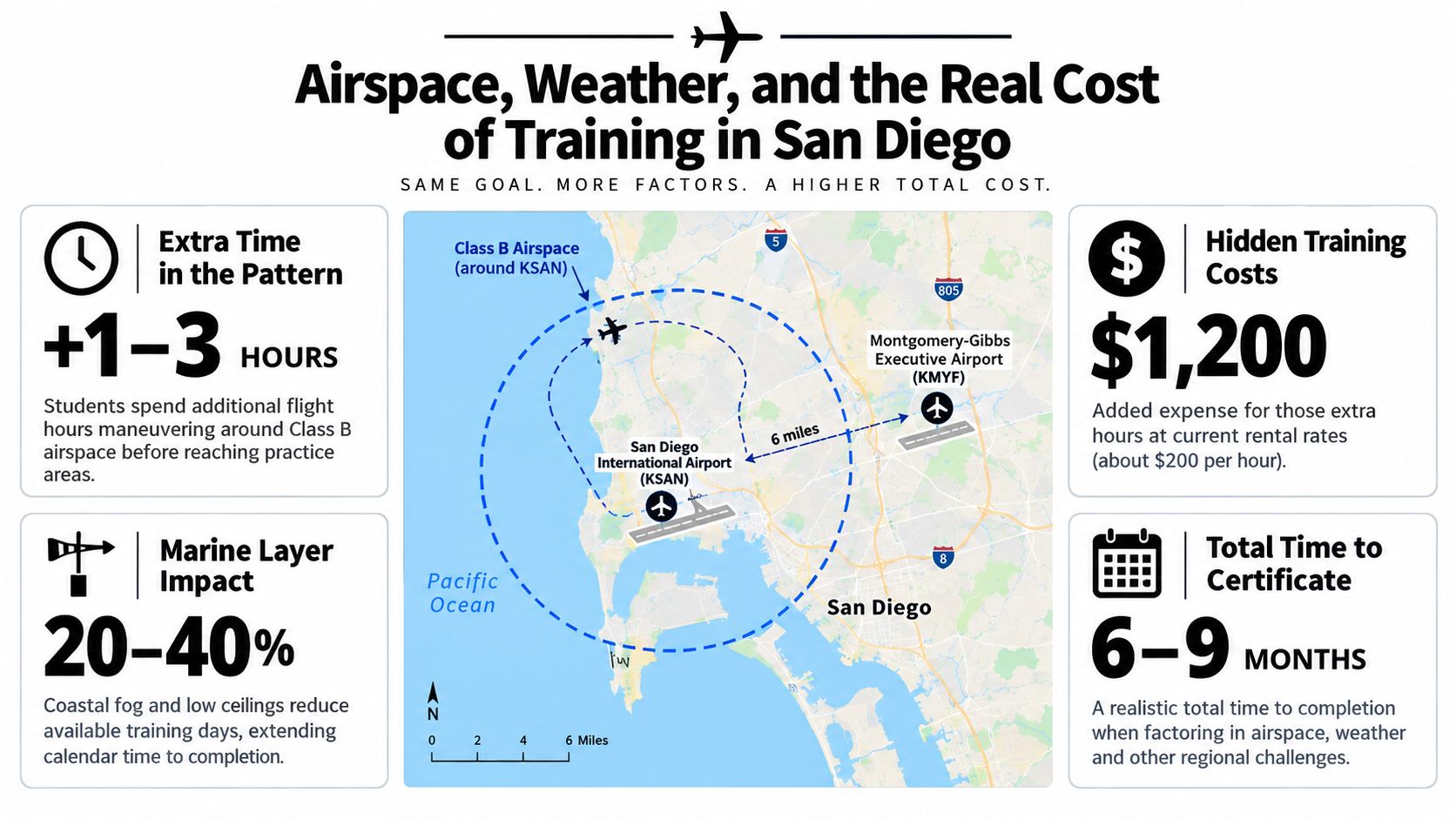
Measure what happens inside the lesson
Busy airspace can create a genuine trade-off. You may complete fewer maneuver repetitions while gaining valuable experience managing clearances, navigation, and cockpit workload.
Read this explanation of controlled airspace, then ask instructors to distinguish productive transit training from avoidable delay.
- Lesson utilization: Request a sample lesson showing taxi, transit, maneuvers, and debrief.
- Solo restrictions: Ask which routes, airports, and conditions require additional authorization.
- Weather recovery: Ask how coastal low ceilings or other unsuitable conditions change the day's plan.
- Airport alternatives: Verify who approves a different training or examination location.
Budget for readiness without an appointment
A 2025 study reported an average five-week checkride wait, and 91% of responding flight schools identified examiner availability as an operational issue in this research on practical-test access. Those are national findings, not a measured San Diego wait time.
Don't convert that average into a promised local timeline. Ask for the school's current examiner coverage, recent booking experience, and procedure after weather or maintenance cancels a test.
Build a delay-cost worksheet using your actual quotes: additional aircraft rental, refresher instruction, examiner-related expenses, housing, and living costs. There's no honest universal San Diego surcharge without those inputs. The useful number is what waiting would cost you under the contract you're about to sign.
How to Read Pricing, Financing, and Fine Print
Read the enrollment agreement with a pen, not a calculator alone. Circle every phrase that lets the provider charge more, change the schedule, retain a deposit, or stop training.
Fixed tuition describes a defined scope. It doesn't establish whether examiner fees, retesting, extra preparation, or accommodation are covered. Neither should you assume those items are always excluded; the contract must answer each question.
Turn the quote into an all-in budget
Use this flight-training cost guide as preparation, then ask the school to mark every expense as included, excluded, conditional, or unknown.
| Budget category | Written answer to obtain |
|---|---|
| Aircraft and instruction | Included scope and excess-training policy |
| Tests and examinations | Fees, retakes, and examiner travel |
| Interrupted progress | Refresher flights and aircraft re-rental |
| Living expenses | Housing obligations during delays |
| Withdrawal | Refund calculation and processing conditions |
An unknown isn't a saving. Keep it visible until someone supplies a contractual answer.
Finance the realistic amount
For any lender, compare interest, fees, repayment timing, total repayment, and what happens if you withdraw. If a payment deferral is offered, ask whether interest accrues during it and how that affects the balance.
Don't assume aviation-focused financing has the same protections or eligibility rules as another education loan. Ask for the actual agreement and compare it independently of the enrollment sales discussion.
The BLS projects 7% employment growth for airline and commercial pilots from 2025 to 2035, with approximately 16,400 annual openings, in its pilot occupational outlook. These projections aren't a personal hiring forecast or a reason to accept debt you can't manage.
Contract test: If an expense could force you to stop training, settle how it's handled before you sign.
My recommendation is simple: borrow against a documented training and living budget, not an optimistic graduation date or an assumed future airline paycheck.
Matching School Types to Common Student Profiles
Choose around your binding constraint. A student with savings but limited availability needs a different arrangement from a career changer who can relocate but needs financing. The right recommendation should name what would disqualify the program, not just what makes it attractive.
If you're starting from zero
For a committed career changer willing to relocate, I'd consider a fixed-price accelerated pathway. The condition is that you can protect the required attendance, study, and living budget.
Reject it if financing depends on an assumed immediate flying job, if the location creates an unsustainable commute, or if you haven't tested whether you enjoy instruction in a small airplane. A discovery flight is a better first commitment than a large deposit.
For someone still deciding between recreational and professional flying, I'd favor a private-pilot-first arrangement. Keep the initial commitment narrow while requiring a clear explanation of how later ratings would connect.
If you already hold a private certificate
An independent Part 61 pathway deserves serious consideration when you need instrument and commercial training without restarting a complete package. Bring your logbook and ask for a written evaluation of what transfers into the proposed plan.
- Disqualify scope mismatch: Don't buy an entire pathway when you need selected qualifications.
- Disqualify weak availability: An attractive quote means little if advanced instruction isn't consistently bookable.
- Disqualify vague credit: Require an explanation of how your existing experience applies.
If flexibility or instructing work matters most
For a local hobbyist prioritizing weekends, I'd look for an FBO-based arrangement with a calendar that supports those hours. Evaluate cancellation rules and instructor overlap before choosing on convenience alone.
For a finishing commercial pilot, I'd prioritize documented instructor-training and placement arrangements. If someone offers paid instructing, ask whether it's employment, a conditional placement opportunity, or a contractual hours commitment.
Don't confuse permission to apply with an offer of work. Require compensation terms, scheduling obligations, student-assignment procedures, and termination conditions in writing. No school should receive credit in your comparison for hours it hasn't committed to provide.
Decision Checklist Before You Sign Anything
Bring a written checklist to the enrollment meeting. Ask the representative to attach supporting documents rather than answering every concern verbally.
Use this printable visual to keep the discussion focused.
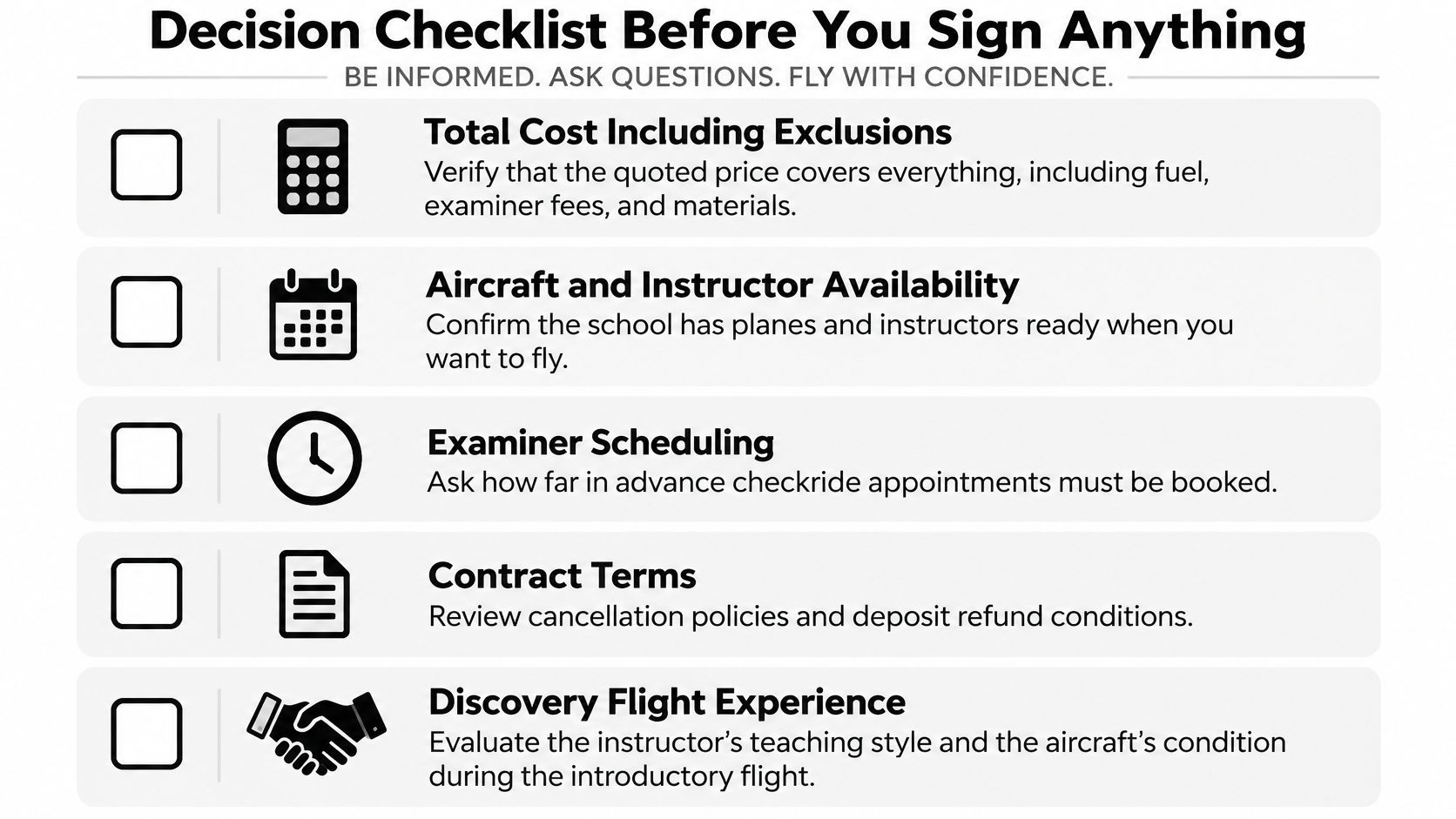
Require evidence, not reassurance
- Total commitment: Obtain the complete quote, exclusions, payment schedule, and refund agreement.
- Training access: Review an actual booking calendar and the plan for instructor or aircraft changes.
- Examination responsibility: Identify who books, confirms, cancels, and reschedules practical tests.
- Financial resilience: Compare the proposed terms with the financing information, then assess your ability to continue through an interruption.
- Living arrangements: Verify availability, transportation, deposits, and obligations if training takes longer.
- Teaching fit: Evaluate whether the instructor explains clearly, listens to questions, and conducts a useful debrief.
Write down the trade-off you're accepting
Before signing, finish this sentence: I'm choosing this school because I value ___ more than ___. Your answer might favor location over speed, flexibility over a packaged schedule, or price certainty over keeping your current job.
That sentence won't replace due diligence. It will expose a mismatch when an enrollment presentation sounds attractive but doesn't solve your actual problem.
If you haven't flown, book a discovery flight and bring the checklist. If you're ready for a complete pathway, request the enrollment documents and compare them against your budget before paying a deposit. Don't leave the meeting with unresolved assumptions disguised as answers.
CFII offers a Southern California pathway from zero experience through instrument-instructor and multi-engine qualifications for students considering regional alternatives to flight schools in San Diego. Visit CFII to discuss your starting point, review the program's written scope, and decide whether its locations and training commitment fit your career plan.
Planning to fly for a living?
See what the path from zero to a pilot career looks like, what it costs and how long it takes.
Learn to fly in Riverside
We train at Riverside Municipal Airport in modern airplanes with a parachute built in. Start with a one hour discovery flight, no experience needed.