
On this page
- How to read a chart in three steps
- Layers of Risk Control
- The same question, asked at every boundary
- Equipment and Clearance Requirements by Class
- Talking is not the same as cleared
- VFR Weather Minimums by Class
- A worked example at 3,000 feet
- Communication Comes First
- The sequence before the boundary
- Two-Way Radio Before You Enter
- The steps and the mistake inside each one
- Uncontrolled, Overlapping and Special Use Airspace
- When outlines stack on the same spot
- Special use airspace, quickly
- Decide Your Next Step Into Flight Training
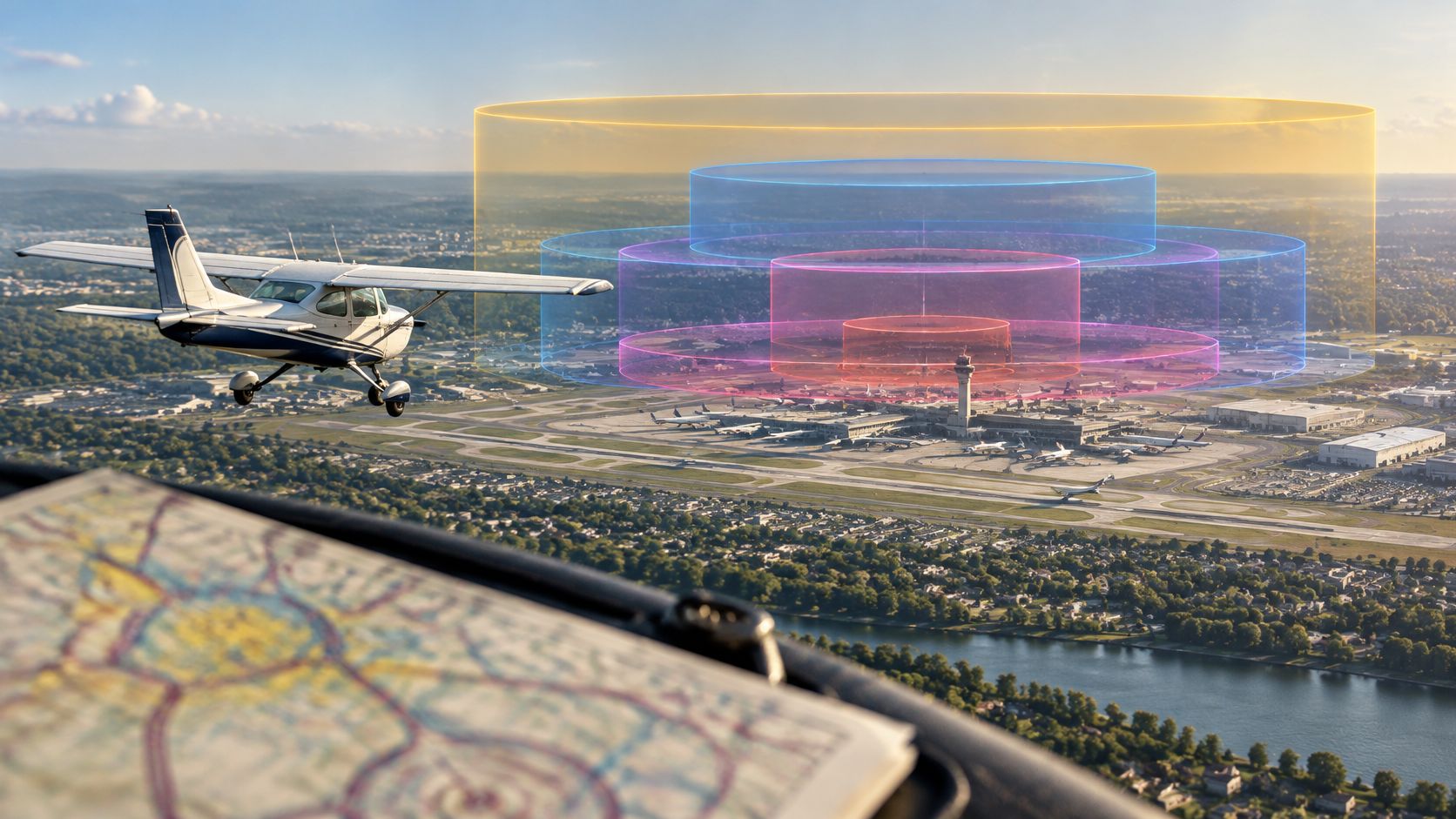
You're at the kitchen table with a sectional chart, tracing a route toward a bigger airport, and the paper in front of you shows a solid blue ring, a solid magenta ring, and pale shading across a lot of the map. Those marks don't mean the same thing, and only one of them is about permission to enter. The others tell you who is watching the traffic and which weather rules apply at the altitude you picked.
The seven classes are the first cut. The FAA's airspace chapter splits U.S. airspace into regulatory and nonregulatory categories and designates the principal classes A through G. Here they are as a lookup table you can read straight off the chart.
| Class | Vertical limits | Who may fly | ATC service |
|---|---|---|---|
| A | 18,000 ft MSL through FL600 | IFR only, with clearance | Full separation for all aircraft |
| B | Surface to 10,000 ft MSL around the busiest airports | IFR or VFR with explicit ATC clearance | Separation for cleared aircraft |
| C | Surface to 4,000 ft above airport elevation | IFR or VFR after two-way radio contact | Separation between IFR and VFR |
| D | Surface to 2,500 ft above airport elevation | IFR or VFR after two-way radio contact with the tower | Tower control at the airport |
| E | Surface or a designated altitude up to 18,000 ft MSL | IFR or VFR, no clearance needed for VFR | Service for IFR traffic |
| G | Surface up to the base of the overlying Class E | IFR or VFR, no clearance | None, pilot sees and avoids traffic |
Class A is the one you read about first and fly into last. It begins at 18,000 feet MSL and runs through and including FL600, and the boundary plus the operating rule sit in 14 CFR Part 71, specifically §§ 71.31 and 71.33. VFR isn't an option up there. Class B wraps the busiest airports from the surface to 10,000 feet MSL in shelves people describe as an inverted wedding cake. Class C normally reaches 4,000 feet above airport elevation, Class D reaches 2,500 feet above airport elevation, Class E is the controlled airspace left over below 18,000 feet, and Class G is whatever hasn't been designated as anything else.
How to read a chart in three steps
- Name the class. Boundary style gives you the first clue before you read a single number. Solid blue, solid magenta, dashed blue, dashed magenta, shaded.
- Read the floor and the ceiling as printed. Those stacked numbers are the governing limits, not estimates and not heights above the ground you assume from the airport diagram.
- Check your planned cruising altitude against both numbers. A shelf you clear laterally can still catch you vertically on climb-out or descent.
Do that in that order and you'll catch the mistake that grounds most student cross-country planning: reading the ring, ignoring the number.
Layers of Risk Control
Think of airspace as a building where each floor has its own access badge. The top floor is the busy one, and the door wants an IFR clearance, a radio, an altitude-reporting transponder and a pilot rated for instruments. Every floor below loosens one of those requirements. By the ground floor, the badge reader is gone and you walk in on your own judgment and a good traffic scan.
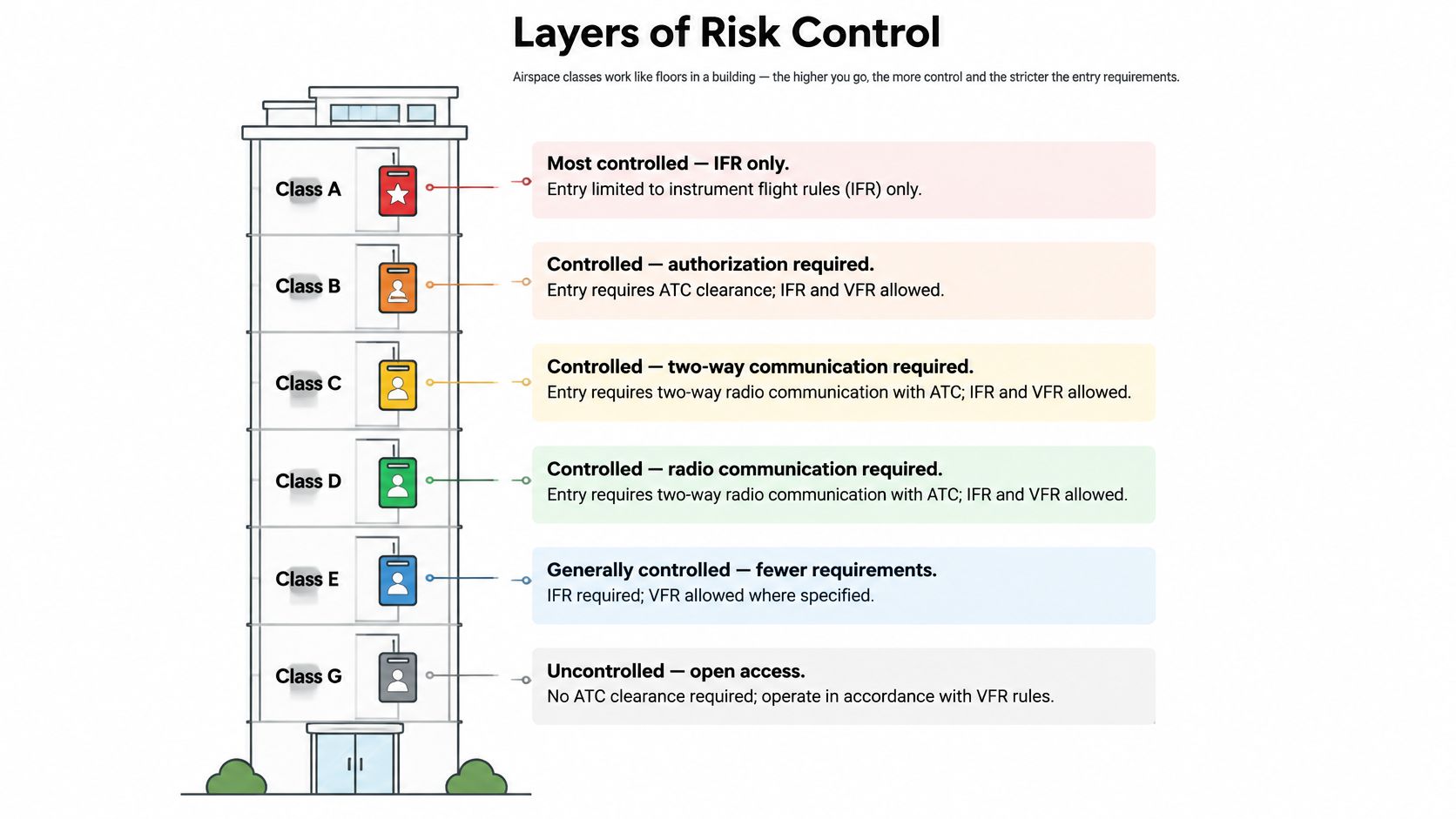
That badge metaphor isn't decoration. The ICAO airspace planning manual treats an airspace class as a bundle of specific variables: flight type allowed, separation standard, air traffic service provided, weather requirements, speed limitation, radio requirement and whether a clearance is needed. Change any one of those and you've changed the class. This is why airspace design is really collision-risk management written into regulation, and why controller workload sits behind the numbers.
The same question, asked at every boundary
Lower ATC participation transfers traffic detection from the controller to you. That's the whole trade. In Class B, a controller is actively keeping airplanes apart, and your job is to fly the assigned heading and altitude precisely. Over a grass strip in Class G, nobody is separating anything, so your job becomes a disciplined scan, a predictable pattern entry, and radio calls that tell the other three airplanes exactly where you are.
Speed limits track the same logic. 14 CFR 91.117 caps you at 250 knots below 10,000 feet MSL, and drops that to 200 knots below 2,500 feet AGL within 4 nautical miles of the primary airport of Class C and D airspace, and in the airspace underlying Class B. Faster airplanes near terminals need predictable geometry, and the rule delivers it.
The question to ask at every boundary: what does this class require of me before I enter, and what protection am I giving up if I stay outside it?
If the difference between the two rule sets still feels fuzzy, spend an hour on IFR and VFR compared before your next chart session. The weather minimums and separation services make much more sense once you see which pilots each class was designed to protect.
Equipment and Clearance Requirements by Class
Three different things can be demanded of you before you cross a boundary: an ATC clearance, a two-way radio contact, or nothing at all beyond the weather rules. Equipment adds a fourth layer on top. Here's how it stacks up.
| Class | ATC clearance | Two-way radio | Transponder with altitude reporting |
|---|---|---|---|
| A | Yes, IFR clearance | Yes | Yes |
| B | Yes, explicit clearance | Yes | Yes, Mode C |
| C | No, but radio contact before entry | Yes | Yes, Mode C |
| D | No, but tower contact before entry | Yes | Generally not required |
| E | No for VFR | Not required for VFR | Required at or above 10,000 ft MSL |
| G | No | Not required | Required at or above 10,000 ft MSL |
Read the first two columns together and a pattern appears. The busiest airspace asks for the most, the quietest asks for the least, and the transponder requirement follows altitude rather than class once you're outside B and C, because 14 CFR 91.215 keys it to flight above 10,000 feet MSL.
Talking is not the same as cleared
This is the distinction that trips up more students than any other. Hearing a controller say your callsign satisfies the radio requirement in Class C and Class D. It does not satisfy Class B, which needs an explicit clearance, and it does not authorize an IFR flight in controlled airspace, which needs a flight plan and an appropriate clearance. The FAA's Aeronautical Information Manual also sets out the hierarchy for overlapping areas, where Class A preempts B, B preempts C, and so on down the line. Beginners rarely see that on a diagram, and it explains why one charted altitude can carry the rules of a class you didn't notice.
"Wilco" and "roger" are acknowledgements. They are not permissions.
Run a short checklist before every flight. Confirm the class your route crosses. Confirm whether entry needs a clearance or just a radio call, and know which one your specific class uses. Confirm the transponder requirement at your highest planned altitude, since that follows the altitude rather than the ring.
Those gates are separate tests and passing three of them still grounds the flight. A crisp radio call into Class D does nothing for a cloud clearance problem, and a legal transponder never fixed a missing clearance. When a boundary on your route is ambiguous, the airspace entry requirements breakdown is worth reading before you plan around it.
VFR Weather Minimums by Class
Legal entry and legal weather are two different questions, and 14 CFR 91.155 answers the second one by class and altitude. You can satisfy every communication requirement on the chart and still be unable to make the flight.
| Airspace | Flight visibility | Cloud clearance |
|---|---|---|
| Class B | 3 statute miles | Clear of clouds |
| Class C and D | 3 statute miles | 500 ft below, 1,000 ft above, 2,000 ft horizontal |
| Class E below 10,000 ft MSL | 3 statute miles | 500 ft below, 1,000 ft above, 2,000 ft horizontal |
| Class E at or above 10,000 ft MSL | 5 statute miles | 1,000 ft below, 1,000 ft above, 1 statute mile horizontal |
| Class G at or below 1,200 ft AGL, day | 1 statute mile | Clear of clouds |
| Class G above 1,200 ft AGL, below 10,000 ft MSL, day | 1 statute mile | 500 ft below, 1,000 ft above, 2,000 ft horizontal |
| Class A | Not applicable, IFR only | Not applicable |
The headline is that Class B and low Class G both let you fly clear of clouds, but for opposite reasons. Class B is so tightly controlled that ATC has already separated you. Low Class G is so quiet that there's almost nobody to separate.
A worked example at 3,000 feet
You're cruising at 3,000 feet MSL in Class E, and the report shows a broken layer with a base at 3,400 feet MSL. That's 400 feet below the clouds. Class E below 10,000 feet MSL requires 500 feet, so you're short.
You have two clean options. Descend to 2,900 feet MSL or lower to open up the required 500 feet, or pick a different altitude entirely. Descending doesn't remove the horizontal rule either, so stay 2,000 feet away from the sides of any puffies you pass. Students tend to fix the vertical number and forget the lateral one.
The full picture is in our guide to VFR minimums, but always verify current values in the Aeronautical Information Manual and 14 CFR 91.155 before you fly, since the numbers matter more than the memory aid.
Communication Comes First
A student on a Class C arrival hears the controller working three other airplanes, assumes the shelf is protecting them, and crosses the outer ring without ever hearing their own callsign. Nothing bad happens. Something is still wrong, because the protection they assumed wasn't active yet.
The FAA's en route guidance is specific: in Class C, separation services begin only after two-way radio communication and radar identification are established. Once those exist, VFR aircraft are separated from IFR traffic using visual separation, 500 feet of vertical separation, or radar target resolution. Before then, the pilot shouldn't assume that entering the depicted area automatically produces the advertised protection.
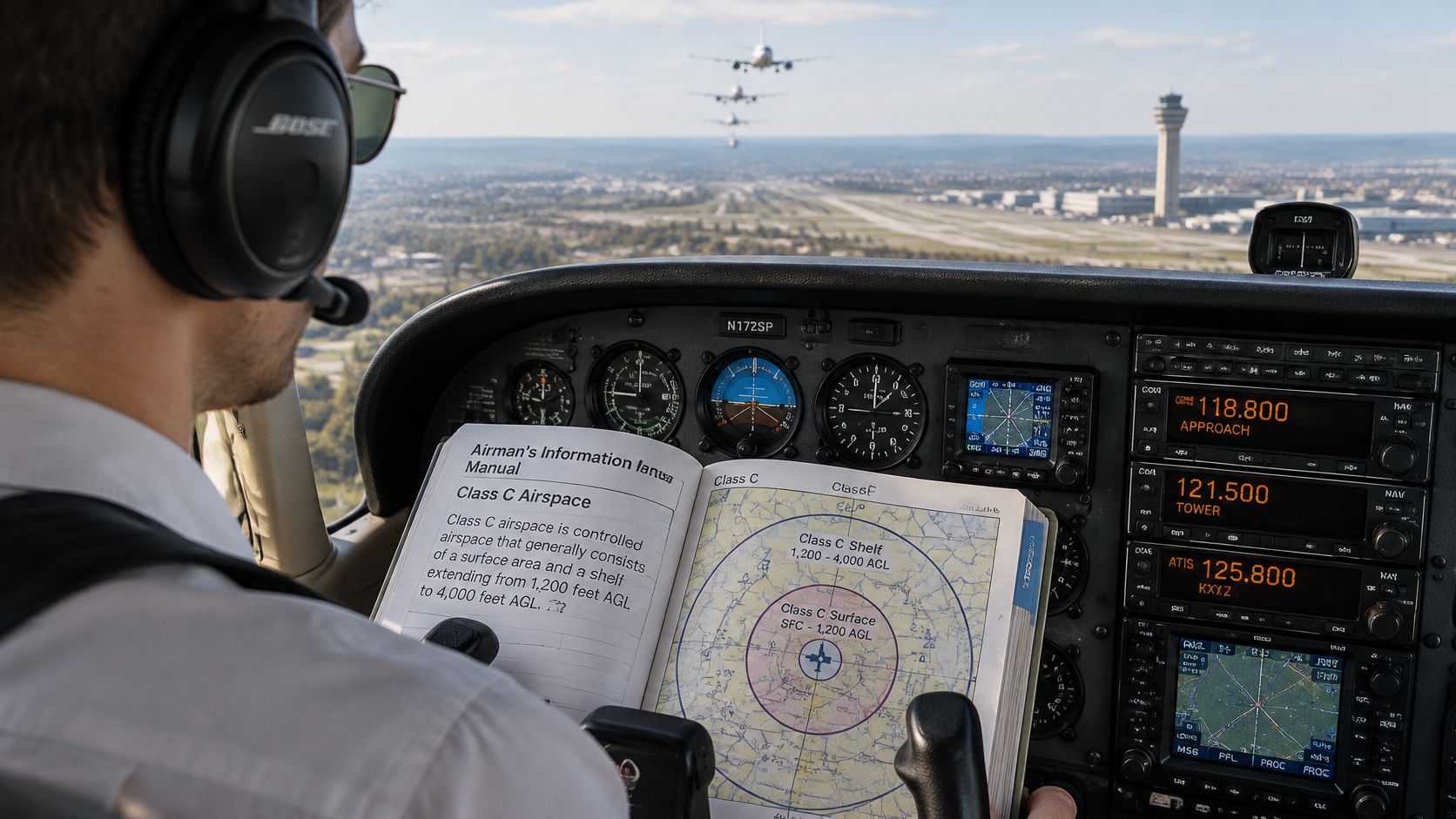
Class B is stricter still. An explicit ATC clearance is required for entry, and cleared aircraft receive separation services. That word explicit carries weight. A "stand by" is not a clearance, and a controller reading back another traffic call is not authorization for you.
The sequence before the boundary
Establish radio contact early, well before the ring, so the controller has time to answer. Confirm the controller has acknowledged your aircraft specifically, not just the frequency. Maintain assigned headings and altitudes without drifting, because the separation was built around them. Treat any loss of communication or uncertain radar identification as an immediate priority rather than a nuisance.
Contact first, confirm second, cross the boundary third. Never reorder those.
If you're unsure how the request itself should sound, practice the phrase with how to request VFR flight following before your next cross-country.
There's a reason our cross-country flights run down the shoreline and over the harbors: students learn to read busy airspace against a coastline before they commit to flying inside it. You can see the shelf, the airport and the traffic flow as one picture from a few miles out, which is exactly how you'll plan it later.
Two-Way Radio Before You Enter
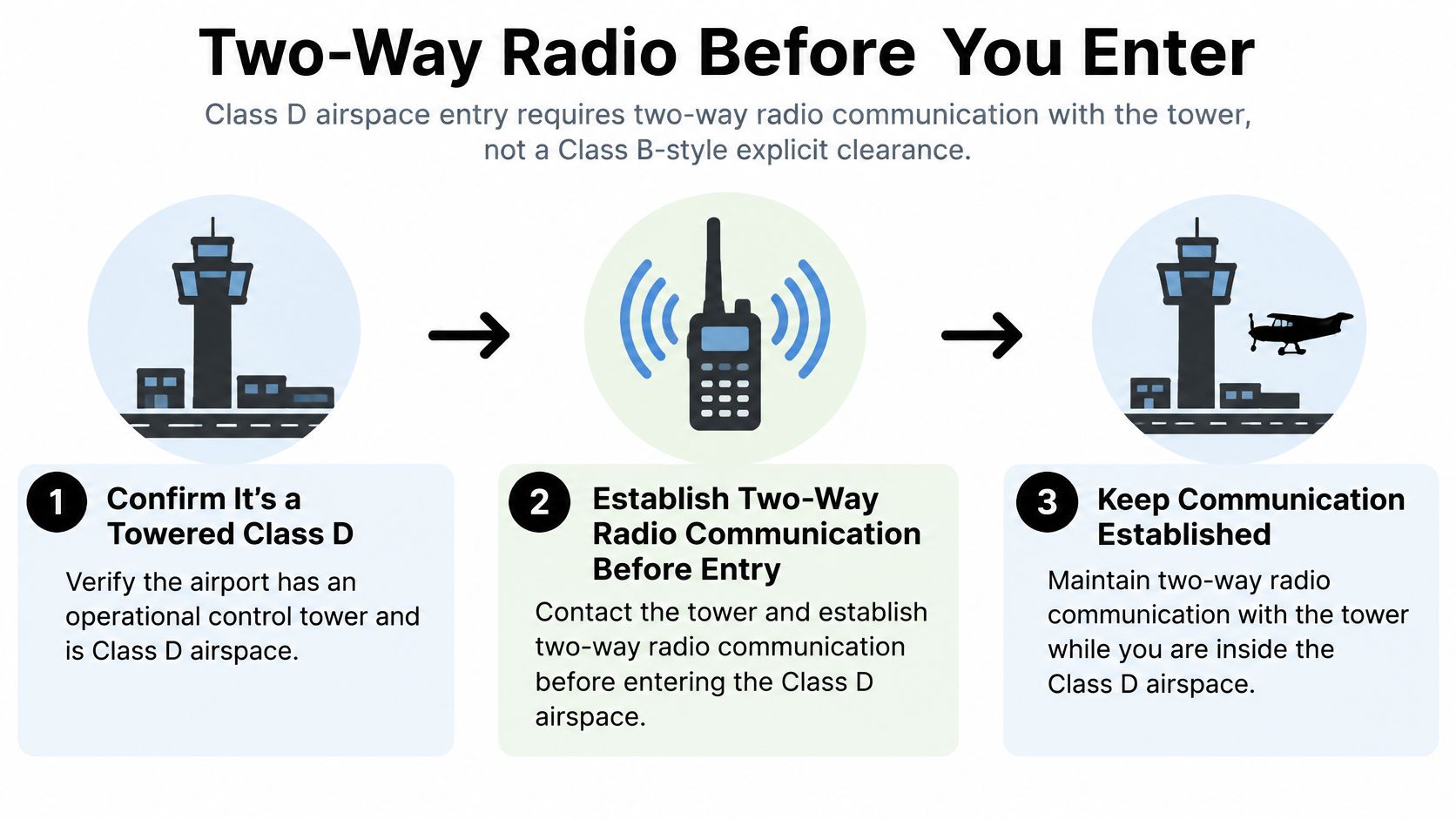
Class D is controlled airspace around an airport with an operational control tower, extending from the surface to 2,500 feet above airport elevation. It is the first controlled airspace most students meet, and its entry rule is the one they most often half-learn. Per the FAA Pilot's Handbook of Aeronautical Knowledge, a VFR aircraft normally must establish two-way radio communications with the tower before entering, and if the tower responds with the aircraft's call sign, communication is considered established. No explicit clearance is required the way it is in Class B.
The steps and the mistake inside each one
- Find the Class D area and read the top. The FAA charts that top in MSL, so read the published altitude instead of assuming every Class D has the same height above the ground. The common slip is assuming 2,500 feet above the field means 2,500 feet on the altimeter.
- Check whether the tower is open. Class D can be absent or reduced when the tower closes, and the chart plus current airport information tell you what remains active.
- Contact the tower before you enter, with your callsign, position and intentions in one short transmission.
- Confirm contact, not just a reply. If the response includes your call sign, you're established. If the tower is talking to somebody else, you aren't.
- Comply with instructions, the traffic pattern and the rest of Part 91. Communication gets you in. Compliance keeps you legal once you're there.
- Keep position reports short and specific. "Three miles southeast, inbound for the left downwind" beats a paragraph.
Heads up on one more thing: those six steps get you legally into the area, and they don't move the responsibility off your shoulders. Radar advisories from the tower help you see traffic. They don't transfer see-and-avoid to the controller.
Uncontrolled, Overlapping and Special Use Airspace
A student points at a shaded block on the sectional and calls it a Class B shelf. It isn't. Shading on a sectional often marks the base of controlled airspace sitting above uncontrolled airspace, which means the ground under the shade is Class G and the sky over it isn't. The FAA Pilot/Controller Glossary defines Class G as airspace that has not been designated under 14 CFR Part 71 as A, B, C, D or E, and it defines Class E as the controlled airspace that fills the space above, below or between the others.
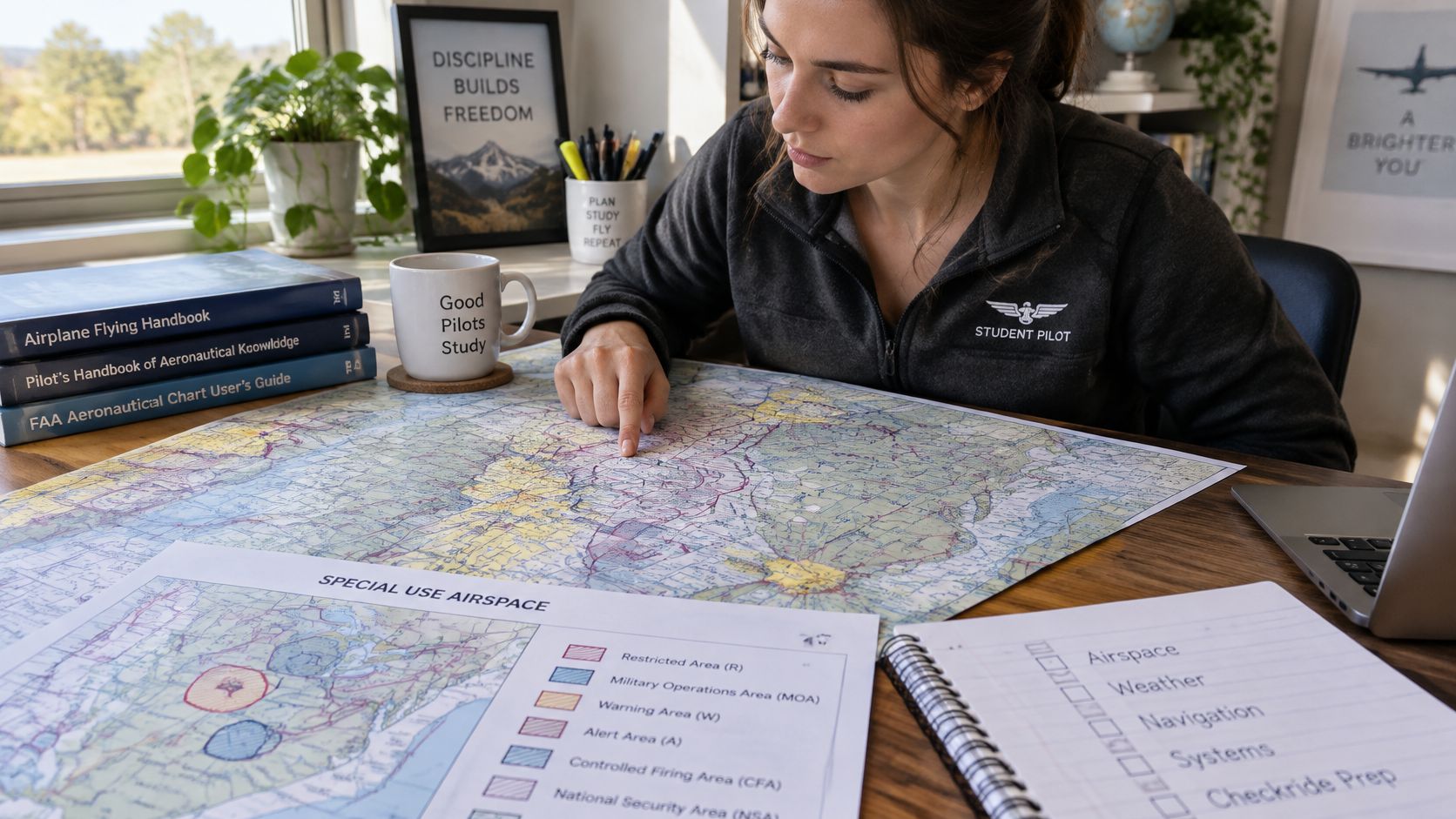
Uncontrolled doesn't mean unregulated. In Class G you still owe see-and-avoid, position awareness, weather compliance and every operating rule in Part 91. What's missing is the ATC separation service. That's the whole difference.
When outlines stack on the same spot
Overlap has an answer, and it's a strict order. Class A preempts B, B preempts C, C preempts D, D preempts E, and E preempts G. One classification governs at any given altitude, even when three outlines cross the same pixel. That's why the altitude number decides, not the most visible ring.
Special use airspace, quickly
Permanent chart features beyond the seven classes include prohibited areas (P), where flight is barred; restricted areas (R), where you need permission from the controlling agency and often an active status check; warning areas (W), which sit offshore over international waters where the U.S. can't prohibit but can warn; military operations areas (MOA), where military training may be underway and VFR flight is legal but demanding; and alert areas (A), which flag unusual concentrations of training traffic. A MOA full of fighters on a Tuesday is a different proposition from the same MOA on a Sunday, so check status rather than avoiding the whole block forever. The special use airspace overview walks through each type and how to check whether it's hot.
Before you read a single charted floor, check for temporary flight restrictions and current NOTAMs. A sectional printed last year won't tell you about the airshow, the wildfire or the stadium game happening this afternoon.
Decide Your Next Step Into Flight Training
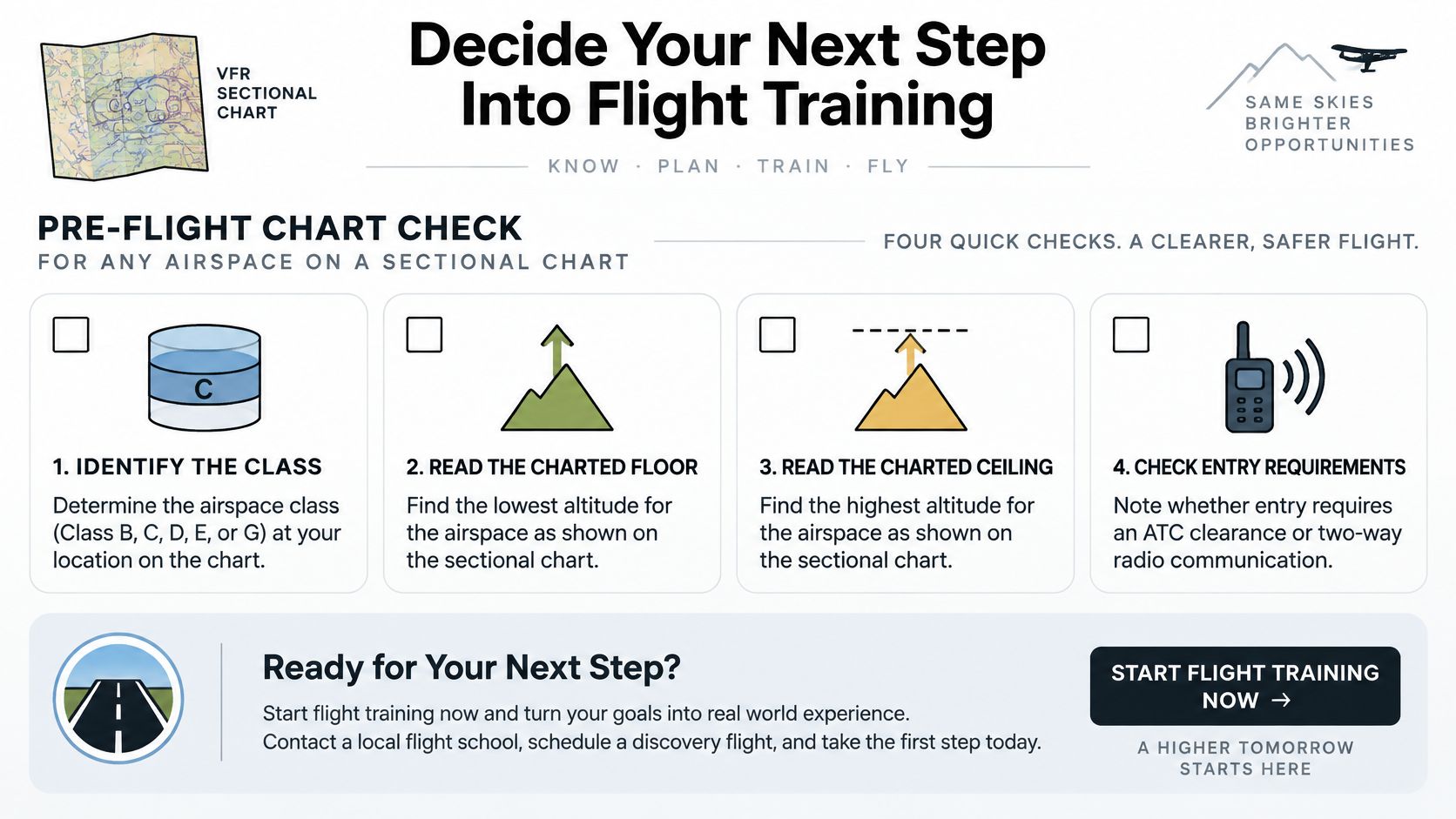
Airspace rewards a repeatable habit more than a good memory. Four checks, in this order, on every route before you launch.
- Name the class for each segment of the flight, including the climb and descent.
- Read the charted floor. It decides where the rules change.
- Read the charted ceiling. It decides where they change back.
- Note the entry requirement and whether it's an explicit clearance, a two-way radio call, or nothing at all.
If you haven't flown yet, start with a discovery flight. It's a first flight with an instructor before you commit to anything, and you can walk the hangar, sit in a cockpit and meet the instructors first. One practical note: a third-class FAA medical certificate from an aviation medical examiner is required before you fly solo, though the discovery flight and your first lessons can happen before you obtain one.
For readers who already know they want the airline path, our Career Track runs from zero time to CFII and multi-engine in about nine months for a fixed $89,000 tuition, with 282 total hours and six certificates and ratings, based in Southern California at Riverside, Long Beach and Corona.
Whichever route you take, ask every school, including us, for the total price in writing, the age of the airplanes, and the instructor turnover rate. Those three answers tell you more than any brochure.
Airspace is the part of flying you can learn completely on the ground, and it's the part that makes your first real flight click into place. CFII teaches it from the chart up, with discovery flights for people who have never flown and a fixed-price Career Track from zero time to CFII and multi-engine across Riverside, Long Beach and Corona. Visit CFII to see the program details, ask about the fleet, and book the first flight that turns those charted rings into something you've flown through.
Planning to fly for a living?
See what the path from zero to a pilot career looks like, what it costs and how long it takes.
Learn to fly in Riverside
We train at Riverside Municipal Airport in modern airplanes with a parachute built in. Start with a one hour discovery flight, no experience needed.