

On this page
- 1. Cessna 172S Skyhawk (Textron Aviation)
- Why it remains the benchmark
- 2. Tecnam P-Mentor (Tecnam)
- A trainer with a parachute for the whole airplane
- 3. Diamond DA40 NG / XLT (Diamond Aircraft)
- Where the DA40 stands out
- 4. Cirrus SR22T G7+ (Cirrus Aircraft)
- Safety by design and by procedure
- 5. Diamond DA62 (Diamond Aircraft)
- Why the mission matters more in twins
- 6. Diamond DA42-VI Twin Star (Diamond Aircraft)
- A twin that rewards standardization
- 7. Piper M600/SLS (Piper Aircraft)
- The case for last-resort automation
- 8. Daher TBM 960 (Daher)
- High performance with a disciplined safety stack
- How a Ballistic Parachute System Works
- Safety Comparison of 8 General Aviation Aircraft
- The Pilot Is the Ultimate Safety System
- Learn to Fly in One of Them
What makes a general aviation aircraft “safe”? Most pilots start with the airframe, but that's only part of the answer. A forgiving trainer, a trainer with a parachute for the whole airplane, a parachute-equipped high-performance single, and a turbine aircraft with emergency autoland can all make a credible safety case for different reasons.
The gap in conventional thinking is that “safest general aviation aircraft” isn't a single-metric question. Accident history matters, but so do survivability, workload management, and the training ecosystem around the airplane. A model can have a strong reputation yet punish weak technique. Another can be more demanding on paper but offset that with automation, envelope protection, and standardized transition training.
This analysis uses four pillars. First, accident data and exposure, meaning how aircraft perform relative to hours flown, not just raw accident counts. Second, crashworthiness and survivability, or how the structure, restraints, and cabin design protect occupants when something goes wrong. Third, accident avoidance, which includes handling qualities, avionics, automation, and systems that help pilots stay out of trouble. Fourth, training and support ecosystem, because aircraft backed by strong factory guidance, instructor familiarity, and disciplined owner communities usually produce better real-world outcomes.
The eight aircraft below are grouped by what they are for, not ranked from first to last: two trainers, two piston singles, two twins and two turboprops. One disclosure up front: CFII trains in the Tecnam P-Mentor, the second airplane on the list, so we say plainly where its record is still short.
Get the framework wrong and you may buy complexity you don't need. Get the framework right and you'll choose an aircraft that fits your mission, proficiency, and margin for error.
1. Cessna 172S Skyhawk (Textron Aviation)

The Cessna 172 is still the reference point because it combines forgiving behavior with decades of fleet exposure. In a long-running review cited in aviation safety commentary, the 172 held fatal crashes in the range of about 0.50 to 1.00 per 100,000 flight hours and was described as the lowest among 33 popular aircraft models evaluated, which is why it still anchors many discussions of the safest general aviation aircraft (historical safety commentary on the Cessna 172).
That matters for methodology. Hours-based fatal rate is far more useful than counting headlines, because trainers fly constantly and often in high-workload environments such as pattern work, stalls, and instrument instruction. A type that stays near the bottom of the fatal-rate stack despite that exposure has earned serious analytical weight.
Why it remains the benchmark
The 172S earns its place less through one breakthrough feature than through system simplicity. High-wing visibility, stable pitch behavior, modest landing speeds, and broad instructor familiarity all reduce the odds that a routine error turns into a fatal chain. New aircraft add Garmin G1000 NXi avionics, which improve situational awareness without changing the airplane's basic temperament.
Practical rule: If your flying mix includes primary training, instrument work, club rental, or family VFR trips, the safest choice often isn't the most capable aircraft. It's the one that gives you the most margin while you're distracted, rusty, or behind the airplane.
A few tradeoffs are real:
- Best fit for training and proficiency: The Skyhawk rewards disciplined basics and makes it easier to maintain them.
- Large support network: Textron parts, service, and instructor familiarity lower operational friction across the U.S.
- Mission limits: Payload, density altitude, and cruise performance can push some owners into missions the airplane doesn't serve well.
That's why the 172 remains such a durable baseline. It doesn't try to rescue poor mission planning with power or complexity. It prevents many bad situations from developing in the first place. For pilots building habits, that's often the strongest safety feature available. Textron's current model details are on the Cessna Skyhawk product page.
2. Tecnam P-Mentor (Tecnam)
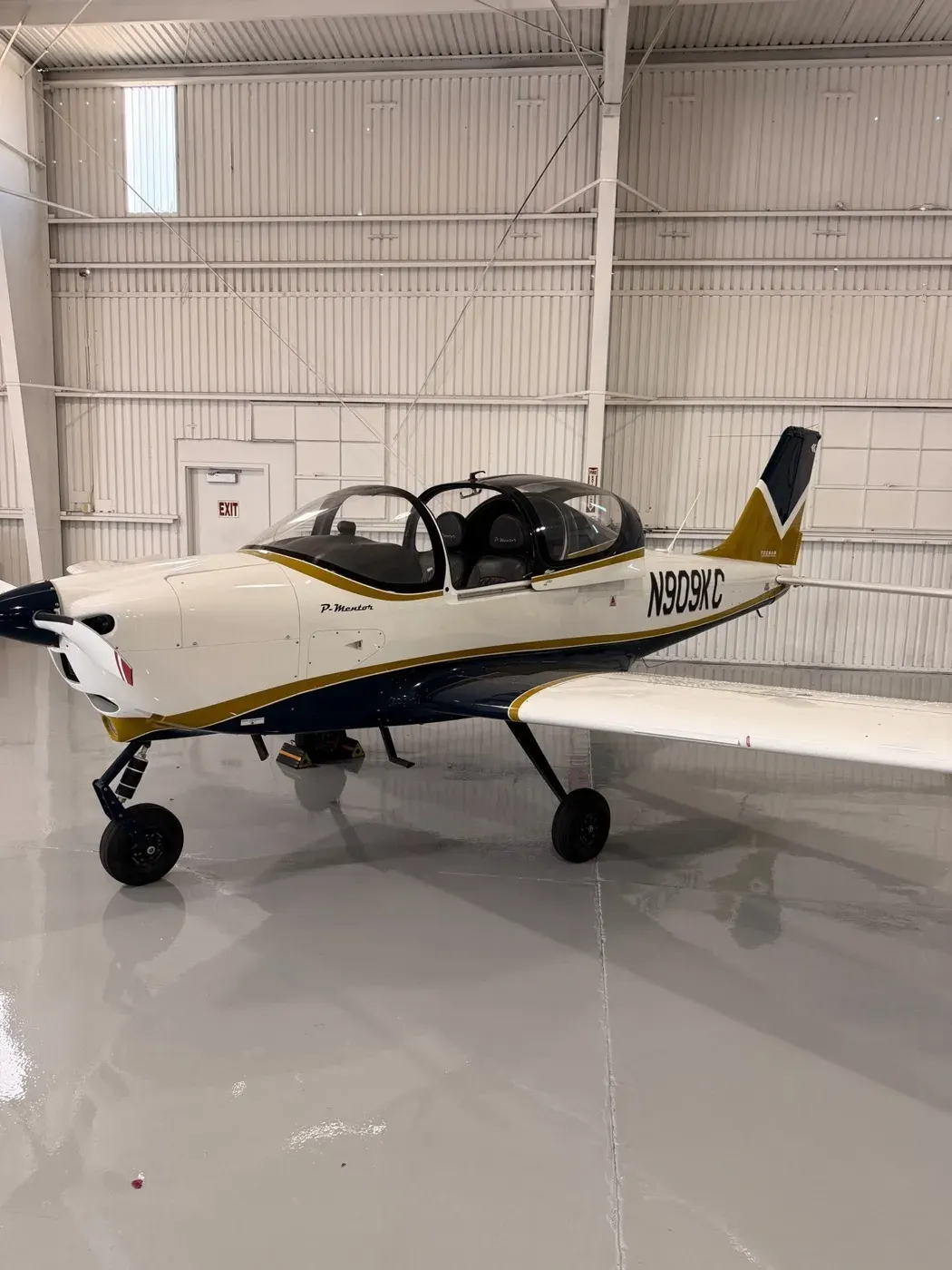
The Tecnam P-Mentor is a two seat, low wing trainer built in Italy and certified under EASA CS-23 and FAA Part 23. It was designed from the start as a training airplane for the whole path from first lesson to instrument rating, and it brings three things most of the training fleet does not have: a modern glass cockpit, a real autopilot and the option of a ballistic parachute for the whole airplane.
Its limit as a safety pick is honest and simple. The P-Mentor is a new type, so it does not have the decades of fleet hours behind the Cessna 172's accident rate. Its case rests on design and equipment, not on a long statistical record yet.
A trainer with a parachute for the whole airplane
Tecnam offers the P-Mentor with a BRS ballistic recovery parachute as a factory option. Pull one handle in the cabin and a rocket pulls the parachute out of the airframe, so the whole airplane comes down under canopy with the people inside. That is the same idea as the Cirrus system further down this list, in an airplane a student can afford to learn in.
The rest of the airplane is built around keeping a student out of trouble in the first place:
- Low, forgiving speeds: It stalls at 44 knots with flaps down, which keeps approach and landing energy low.
- Glass cockpit and autopilot: A Garmin G3X panel and a GFC 500 autopilot let a student learn to manage automation early, and give a way to hold the airplane level while sorting out a problem.
- Modern engine: The fuel injected Rotax 912 iS has redundant electronic injection and no carburetor to ice up.
- IFR equipped: The same airplane takes a student through instrument training, so there is no jump to an unfamiliar cockpit in the middle of training.
- The tradeoff: Two seats and 100 horsepower make it a trainer, not a family traveling airplane, and the parachute is an option, so not every P-Mentor has one.
Every airplane in the CFII fleet at Riverside Municipal Airport is a P-Mentor with the BRS parachute fitted. It is the airplane our students fly from zero experience to commercial pilot and flight instructor in the Career Track. You can see the airplane and its equipment on our fleet page, and Tecnam publishes the specifications on its P-Mentor page.
3. Diamond DA40 NG / XLT (Diamond Aircraft)
If the 172 is the classic benchmark, the DA40 is the modern evidence-based challenger. It has built a reputation around a combination many aircraft don't deliver at once: docile handling, strong visibility, modern avionics, and a design philosophy that treats survivability as part of safety rather than an afterthought.
That's the key distinction. Some airplanes are hard to crash. Others are better at protecting occupants when a crash happens. The DA40's appeal is that it tries to do both.
Where the DA40 stands out
Diamond's safety case centers on the cabin safety cell, restraints, energy management, and predictable handling near the stall. In practical terms, that makes the DA40 especially attractive to owners who want an IFR-capable piston single without moving into the workload and speed profile of a more aggressive cross-country platform.
The modern cockpit matters too. G1000 NXi avionics and available integrated autopilot support help with scan discipline and task management, especially in instrument conditions. But the analytical advantage is how those systems sit on top of an inherently stable airframe rather than trying to compensate for a twitchy one.
The safest avionics stack is the one installed in an airplane that remains easy to hand-fly when the pilot turns everything off.
That makes the DA40 one of the strongest all-around picks for pilots who value accident avoidance and survivability in the same package.
- Strong passive safety concept: The structural design and restraint philosophy support occupant protection.
- Low-drama handling: Benign stall characteristics help prevent loss-of-control scenarios from escalating.
- Operational compromise: Parts access and acquisition cost can be less convenient than with legacy trainer fleets.
The DA40 isn't “safe” because it's composite or because it's new. It's safe when flown as intended because Diamond aligned airframe behavior, cabin protection, and modern cockpit support into one coherent design. That's a stronger safety logic than relying on performance alone. Diamond's current specifications are on the DA40 product page.
4. Cirrus SR22T G7+ (Cirrus Aircraft)

The Cirrus SR22T belongs on any serious safest general aviation aircraft list, but not for the simplistic reason often cited. The whole-airframe parachute is important. It changes decision-making at the edge. Yet the stronger case is that Cirrus built a layered safety model: parachute, modern avionics, stability support, factory training culture, and extensive owner standardization.
That last point matters more than many buyers realize. A technically advanced aircraft only improves safety if pilots train to the system, use automation correctly, and deploy the last-resort tools early enough.
Safety by design and by procedure
The Cirrus Airframe Parachute System (CAPS) is standard on every SR22T, which gives it a last-resort option most piston singles do not have. Add Garmin Perspective Touch+ avionics, auto-level style recovery features, and electronic stability protection, and the airplane offers multiple opportunities to interrupt an error chain before impact.
But the airframe isn't self-executing. The SR22T is still a high-performance piston single. It asks more of the pilot in energy management, weather judgment, and systems discipline than a trainer does. That's why Cirrus training culture is part of the aircraft's safety story, not a footnote.
Decision point: In parachute-equipped aircraft, one of the hardest safety tasks is psychological. Pilots have to commit in advance to using the system before altitude, terrain, or weather remove the option.
The SR22T fits pilots who want speed and capability but are willing to operate inside a standardized program.
- Unique last-resort option: CAPS changes the survivability equation in scenarios where control or landing options collapse.
- Strong ecosystem: Type-specific training and owner community support help normalize disciplined operating habits.
- Meaningful downside: Acquisition, insurance, and ongoing system-related costs are higher than trainer-class singles.
For owners flying serious cross-country missions, the SR22T is a case study in risk reduction by layers rather than by simplicity. Current model information is available from Cirrus Aircraft.
5. Diamond DA62 (Diamond Aircraft)

The DA62 is where this ranking has to widen its lens. A twin isn't automatically safer than a single. In fact, the National Transportation Safety Board's safety-study data showed nonmilitary, nonintelligence public aircraft at 3.66 accidents per 100,000 flight hours and comparable Federal aircraft at 4.58, both below the general aviation accident rate of 7.2 during the same analysis period, which points directly to mission discipline and procedures as major safety drivers rather than airframe label alone (NTSB safety study).
That framing suits the DA62 perfectly. It's an advanced traveling machine whose safety value comes from stable IFR behavior, modern avionics, redundancy, and mission matching. It's not a “safe twin” because it has two engines. It's safer when crews use its systems to reduce exposure to weather, workload, and single-point failures.
Why the mission matters more in twins
The DA62's composite safety cell, integrated Garmin flight deck, and available known-icing equipment create a broad operational envelope. For family travel and serious personal transport, that can reduce pressure to launch marginally, divert late, or press on without proper equipment.
Its cabin design also deserves more analytical attention than it usually gets. Good visibility, ergonomic seating, and a modern panel layout improve crew coordination and scan quality. In real safety terms, that means fewer avoidable task-management errors in instrument conditions.
- Best use case: Pilots who need dispatch flexibility, cabin comfort, and genuine IFR capability.
- Strong safety logic: Redundancy, de-ice options, and automation support better risk management on longer missions.
- Primary caveat: Twin-engine capability only helps when the pilot's recurrent training and systems knowledge stay current.
The DA62 doesn't beat simpler singles as a universal answer. It wins for owners whose missions justify its complexity and who are willing to train accordingly. That's a narrower but very credible path to being among the safest general aviation aircraft in its class. Product details are on the Diamond DA62 overview page.
6. Diamond DA42-VI Twin Star (Diamond Aircraft)

The DA42 often makes more sense than larger twins for safety-focused owners because it sits closer to the training environment. That's not a small advantage. Aircraft used widely for multi-engine and IFR instruction develop a culture of standard callouts, repeatable profiles, and instructor scrutiny that many owner-flown aircraft never get.
That ecosystem changes outcomes. Safety isn't just built into the airframe. It's reinforced in every checklist flow, engine-out drill, and recurrent session.
A twin that rewards standardization
The DA42 combines Diamond's crashworthiness concepts with integrated Garmin avionics, autopilot support, and efficient diesel engines. For pilots stepping into twin operations, that makes it one of the more coherent packages available. The airplane is capable, but it doesn't require the same leap in speed and systems management that some legacy twins impose.
Its strongest safety trait may be predictability under structured training. Because so many instructors and schools use the DA42 in formal programs, pilots can find established procedures more easily than in owner-modified legacy twins with mixed avionics and inconsistent instructional practice.
A twin improves safety only when the pilot can identify, verify, and manage an abnormal immediately. Standardization shortens that response time.
A few points stand out:
- Training alignment: The DA42 benefits from broad use in multi-engine and IFR instruction.
- Modern workload control: Integrated avionics and autopilot help pilots stay ahead of the airplane.
- Ongoing demand: Twin proficiency is not optional. Without recurrent practice, the safety case weakens fast.
For pilots who want a modern light twin without the procedural sprawl of older designs, the DA42-VI is one of the most rational choices. It rewards discipline and punishes complacency less harshly than many of its predecessors, which is exactly what a safety analyst wants to see. Current details are available on the Diamond DA42 overview page.
7. Piper M600/SLS (Piper Aircraft)
The M600/SLS marks a different branch of the safety tree. This isn't a benign basic airframe aimed at reducing pilot workload through simplicity. It's a pressurized turbine aircraft that tries to reduce risk through automation, certified safeguards, and better mission capability.
That distinction matters. A high-altitude, fast single-pilot platform can expose the pilot to more complexity. But if the aircraft also gives the pilot stronger tools for weather avoidance, envelope protection, and emergency recovery, the balance can still come out in its favor for the right mission.
The case for last-resort automation
The M600/SLS's defining feature is the HALO Safety System with certified Garmin Autoland. For safety analysis, Autoland belongs in a different category from convenience automation. It's not about reducing button-pushing. It's a final-layer protection against pilot incapacitation or a severe inability to continue the flight safely.
That feature works best when paired with the rest of the platform. Garmin G3000 avionics, Emergency Descent Mode, pressurization, and turboprop performance give pilots more tools to avoid weather and terrain traps before they become emergencies. In other words, the aircraft addresses both prevention and recovery.
- Best safety case: Single-pilot IFR owners who routinely fly complex trips and want certified emergency landing backup.
- Operational upside: Pressurization and turbine performance can reduce exposure to lower-altitude weather and fatigue.
- Major tradeoff: Cost, training, and insurance requirements put this far outside the trainer and piston-single ownership model.
The M600/SLS is not safer because it's more expensive. It's safer for missions that justify its systems, and only when the pilot remains disciplined enough not to let automation expand risk-taking. That's a subtle but important distinction.
8. Daher TBM 960 (Daher)
The TBM 960 is one of the clearest examples of a high-performance aircraft trying to make single-pilot operation more defensible through integrated automation rather than asking the pilot to manually manage every layer of risk. That doesn't make it simple. It makes it more survivable when used with discipline.
Many “safest general aviation aircraft” lists often prove shallow. They lump trainer safety and high-performance turbine safety into one bucket. They're not comparable on workload. They're comparable only on whether the airplane gives the pilot enough margin for its intended mission.
High performance with a disciplined safety stack
Daher positions the TBM 960 around e-COPILOT automation, Garmin-based HomeSafe emergency autoland, autothrottle, level mode, and additional airport-safety functions. In a safety framework, that means the aircraft attacks three separate hazards: incapacitation, workload overload, and energy-management error.
The right analytical question isn't whether the TBM is “safer than a Skyhawk.” It isn't, for a low-time pilot flying short VFR hops. The better question is whether it may be among the safest options for owner-pilots who need turbine dispatch reliability, speed, and advanced automation in a single-pilot platform. On that narrower question, the answer is yes.
High capability helps only when it reduces exposure. If speed just encourages longer launches into worse weather, the safety margin disappears.
Keep the tradeoffs in view:
- Exceptional emergency support: HomeSafe adds a certified last-resort path if the pilot can't complete the flight.
- Automation with purpose: Autothrottle and protection modes reduce workload in critical phases.
- No substitute for discipline: Fast turbine singles still demand strong IFR judgment, recurrent training, and conservative personal minimums.
For pilots whose missions are too demanding for piston aircraft but who still fly single-pilot, the TBM 960 makes one of the most advanced safety arguments in the market. Daher's current specifications are on the TBM 960 page.
How a Ballistic Parachute System Works
Two airplanes on this list, the Tecnam P-Mentor and the Cirrus SR22T, can carry a parachute big enough to lower the whole aircraft to the ground. Both use a system from BRS Aerospace, the company that invented it.
The pilot pulls one handle in the cabin. A small solid-fuel rocket fires and pulls the packed parachute out and away from the airplane, clear of the propeller and the tail. A ring on the lines called a slider holds the canopy back from opening all at once, so the opening shock stays survivable. Then the airplane descends under the canopy, and the landing gear and seats absorb most of the touchdown.
The parachute does not replace flying the airplane. It is for the situations where flying is no longer an option: a midair collision, a structural failure, a pilot who has become incapacitated, or an engine failure over terrain with nowhere to land.
The record is why it belongs in a safety ranking. BRS counts more than 510 lives saved across every aircraft its parachutes are fitted to (BRS Aerospace), and AOPA counted 269 lives saved by the Cirrus parachute alone by the end of 2024. The Cirrus experience also shows that the parachute only helps pilots who are trained to pull it early, which is why it is briefed as a standard procedure and not left as an afterthought.
Our guide to planes with parachutes covers which airplanes have one, how often they are repacked and what the numbers show, with sources.
Safety Comparison of 8 General Aviation Aircraft
| Aircraft | Type | Main safety case | Whole-airplane parachute | Best for |
|---|---|---|---|---|
| Cessna 172S Skyhawk | Piston trainer | Forgiving handling and the longest fleet record | No (retrofit kit exists) | Primary and instrument training, rental |
| Tecnam P-Mentor | Piston trainer | Low stall speed, glass cockpit, autopilot, optional parachute | BRS, factory option | Career training from first lesson through instrument |
| Diamond DA40 NG / XLT | Piston single | Cabin safety cell and benign stall behavior | No | IFR training and owner flying |
| Cirrus SR22T G7+ | High-performance piston single | CAPS parachute, stability protection, type training | CAPS, standard | Fast personal cross-country travel |
| Diamond DA62 | Piston twin | Two engines, known-icing option, stable IFR platform | No | Family and multi-passenger IFR travel |
| Diamond DA42-VI Twin Star | Piston twin | Standardized multi-engine training culture | No | Multi-engine and IFR training |
| Piper M600/SLS | Turboprop single | HALO system with Garmin Autoland | No (emergency autoland) | Single-pilot IFR cross-country |
| Daher TBM 960 | Turboprop single | HomeSafe autoland, autothrottle, envelope protection | No (emergency autoland) | High-speed single-pilot travel |
The Pilot Is the Ultimate Safety System
The aircraft on this list reach safety through different paths. The Cessna 172 does it through simplicity, benign handling and a deep training culture. The Tecnam P-Mentor adds a glass cockpit, an autopilot and an optional parachute to the trainer class. Diamond's singles and twins lean on structural protection, stable flight characteristics and coherent cockpit design. Cirrus adds a last-resort recovery layer and a standardized operating culture. Piper and Daher use turbine reliability, envelope protections and emergency autoland to defend complex single-pilot missions.
The broader data points to the same conclusion. The FAA says the U.S. general aviation community includes more than 275,000 aircraft, and that 2024 produced the lowest GA fatal accident rate since tracking began in 2009 (FAA 2025 General Aviation Safety Fact Sheet). That is not evidence that one model has solved safety. It is evidence that training, procedures, technology and culture are improving together.
Pilot proficiency remains the hinge point. Recurrent training, realistic personal minimums, aircraft-specific systems knowledge and disciplined use of automation matter more than any single brochure feature. The safest aircraft is usually the one you train in most often, understand most thoroughly and operate with the least unnecessary complexity.
Learn to Fly in One of Them
If you are choosing where to train, the airplane is part of the decision. Most flight schools still teach in Cessnas and Pipers built decades before glass cockpits and whole-airplane parachutes existed. At CFII, every lesson of the Career Track is flown in a new Tecnam P-Mentor with a Garmin glass cockpit, an autopilot and a BRS parachute, out of Riverside Municipal Airport in Southern California. The program takes you from zero experience to commercial pilot and flight instructor in about nine months.
The easiest way to judge the airplane is to fly it. Book a discovery flight and you will sit in the left seat, fly it yourself with an instructor beside you and see the parachute handle for yourself.
Planning to fly for a living?
See what the path from zero to a pilot career looks like, what it costs and how long it takes.
Learn to fly in Riverside
We train at Riverside Municipal Airport in modern airplanes with a parachute built in. Start with a one hour discovery flight, no experience needed.